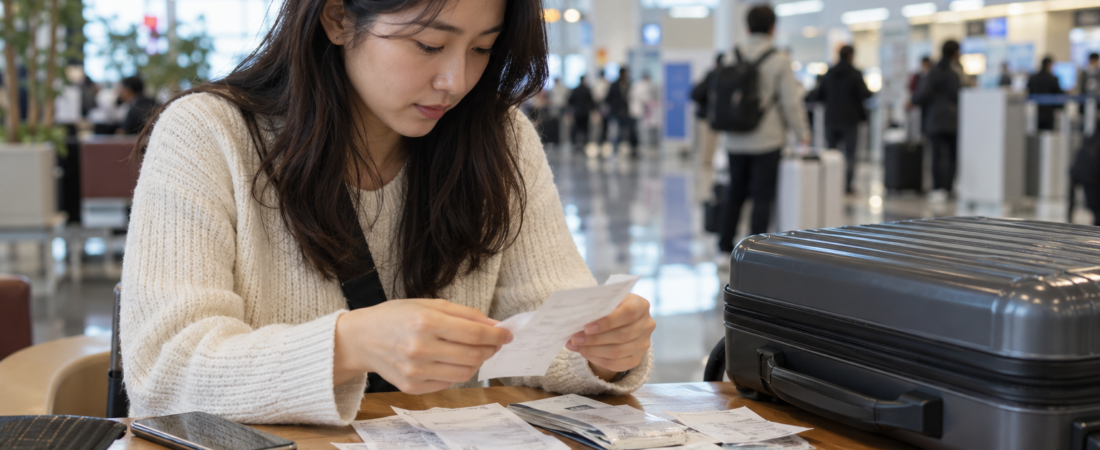
A Korean tax refund is easiest when you prepare at the shop, not when you reach the airport with an unexplained stack of receipts. The crucial question is whether the store deducted the tax at purchase or issued a refund document for you to process later. An ordinary shop receipt alone may not be enough. This guide follows current Incheon Airport and Korea Tourism Organization instructions.
Header image illustrates paperwork preparation; it does not show a real refund counter or official airport sign.
First, identify which refund you have
At a participating store, ask whether the purchase is eligible and show your passport if requested. The Korea Tourism Organization distinguishes an immediate tax refund, where the tax is deducted at checkout, from a general refund, where you pay the tax-inclusive price and later claim a refund with a voucher. Both have eligibility rules. The tourism organization lists a minimum purchase of ₩15,000 for eligible goods; the airport describes purchases over ₩15,000. Check the current operator’s threshold at checkout rather than assuming every shop and item qualifies.
| What happened at the shop? | What to keep | Likely next step |
|---|---|---|
| Tax deducted immediately | Receipt and purchase record | Check whether departure confirmation is still required for that purchase. |
| Full price paid; refund voucher issued | Voucher, receipt, passport and eligible goods | Follow the airport kiosk/customs process before collecting the refund. |
| Only a normal receipt | The receipt | Ask the shop or operator whether a claim is possible; a receipt does not itself create a refund entitlement. |
At checkout say, “Tax refund, please,” and check the details on the voucher. Pair each shop’s voucher and receipt. Do not estimate your refund by multiplying the price by the VAT rate; eligibility and operator method matter.
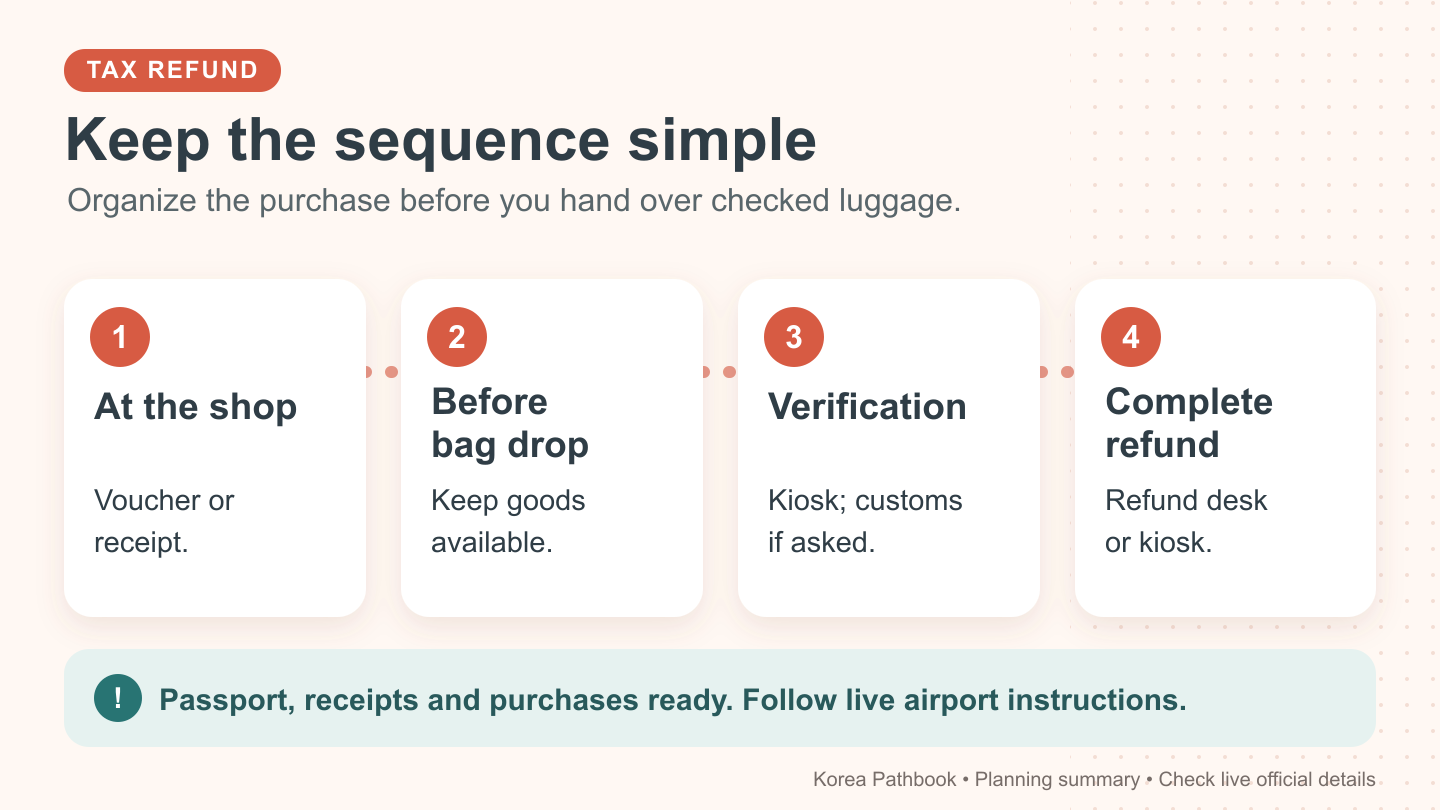
Before checking a bag, make the goods available
Incheon Airport separates the procedure according to where refund-eligible goods will travel. For carry-on luggage, keep goods and documents with you and use the departure-hall refund kiosk after check-in. If it calls for inspection, present your passport, unused goods and purchase confirmation to customs. Do not put the goods or papers in checked luggage before this step.
If the goods must go in checked baggage, tell airline staff at check-in that the bag contains tax-refund items. The airport instructs travelers to have the bag tagged, reclaim it for the kiosk and possible customs inspection, then place the cleared bag on the large baggage conveyor beside customs. Handing the suitcase over at an ordinary bag-drop line first can make inspection impossible. Leave time for this detour; approval is not automatic.
Packing tip: put potentially inspectable purchases near the top of the suitcase. Keep passport and vouchers in hand luggage. Check the operator’s conditions before relying on a refund for an opened product.
Where to collect the refund at Incheon
Once the kiosk/customs stage is complete, follow your voucher and airport signs to a staffed refund desk or automated kiosk in the duty-free zone. Incheon Airport currently lists these main locations:
| Terminal | Staffed desk | Automated kiosk |
|---|---|---|
| Terminal 1 | 3F duty-free zone near Gate 28; listed 07:00–22:00 | Near Gate 28; listed 24 hours |
| Terminal 2 | 3F duty-free zone near Gate 253; listed 07:00–21:30 | Near Gate 253; listed 24 hours |
These are airport-listed locations and hours, not a promise every operator or payment method is available there. Read your voucher; ask an information desk if its counter differs. The airport says kiosks process approved records after a passport scan and may offer a card credit. Keep the voucher until payment clears.
A five-step departure plan
- During shopping: confirm that the store participates, show your passport, and request the correct refund voucher.
- At your hotel: separate immediate refunds from general refund vouchers; pair each voucher with receipt and goods.
- At check-in: tell the airline before handing over a suitcase containing goods that may require inspection.
- In the departure hall: use the refund kiosk and follow any instruction to present goods to customs.
- After security: find your operator’s desk or kiosk, collect or arrange the refund, then keep paperwork until payment clears.
For a late-night flight, the airport lists 24-hour automated kiosks but shorter staffed-desk hours. Plan around the service you actually need rather than assuming a person will be available. Confirm the right terminal for your flight before starting. Use our Incheon Airport Terminal 1 vs Terminal 2 guide to plan your route, and verify your flight’s current terminal with the official flight search.
What commonly goes wrong?
No voucher: an ordinary receipt may not replace it. Goods already checked in: customs may be unable to inspect them. Wrong terminal or provider: Gate 28 and Gate 253 are not interchangeable; follow your voucher. Too little time: never risk missing a flight to claim a refund. The order of steps matters.
Last checked: October 5, 2026. Rules, counters and hours can change; confirm with shop, operator and airport before departure. Official sources: Incheon Airport refund procedure and locations and Korea Tourism Organization tax-refund guide. Where counter details differ, this article uses the airport’s listing.
Related Korea Pathbook guides: Foreign credit cards in Korea and the first-trip checklist.
Plan your next step: Before departure, confirm your correct airport terminal. If your journey involves an airport change, use the Incheon-to-Gimpo transfer checklist; the refund process does not replace the time needed for check-in, security and that transfer.