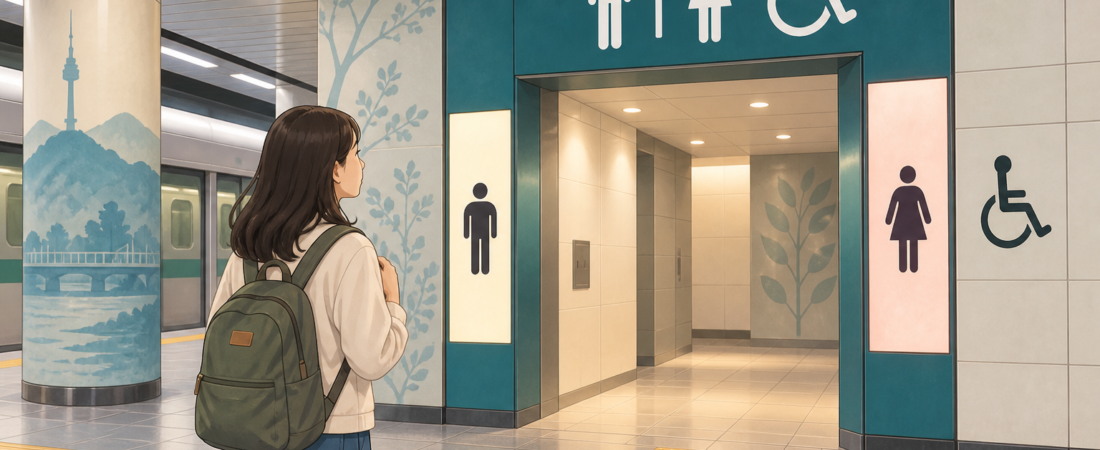
Finding public toilets in Korea is easier if you know one useful word: 화장실, meaning toilet or restroom. Search it in your map app or show it to staff. In Seoul, subway stations are a useful starting point; the city’s transport guide identifies public restrooms as a station facility. Still, check the actual location and access rather than assuming a toilet is outside the fare gates.
This is a practical navigation guide, not a promise that every mapped restroom is open, free, step-free, or equipped in the same way. Hours, maintenance closures, and access arrangements depend on the building and operator.
Need a restroom near you right now?
Search 화장실 (restroom) or 공중화장실 (public toilet) around your current location in a live map app. Open the result to check the actual entrance, floor and access before walking there. This page explains the search process; it cannot detect your location or confirm that a restroom is open or within a particular distance. If you are in Seoul, use our Seoul public-toilet map guide for official map resources and a worked example.
- Centre the map on where you are, then search using the Korean words above. If location access is off, use a nearby station or landmark as your starting point.
- Compare the walking route and the actual building entrance. A nearby pin may involve stairs, a crossing or access through a station gate.
- Check access with staff if the listing is unclear. Show: 지금 이용할 수 있는 화장실이 어디예요? (Where is a restroom I can use now?)
- If it is closed or restricted, ask for the next accessible option rather than relying on the same map pin.
Where to look first
| Location | Useful check |
|---|---|
| Subway or railway station | Is the restroom before or after the ticket gates? |
| Public park or civic facility | Is it open at this hour and reachable on your route? |
| Museum or attraction | Does access require entry to the attraction? |
| Shopping center | Which floor, and are the building entrances still open? |
| Cafe or restaurant | Is it for customers, shared with the building, or opened with a code or key? |
Useful words to recognize
| Korean | Meaning |
|---|---|
| 화장실 | Toilet / restroom |
| 남자 / 남성 | Men |
| 여자 / 여성 | Women |
| 장애인 화장실 | Accessible toilet |
| 사용 중 | In use |
| 청소 중 | Cleaning in progress |
| 고장 | Out of order |
| 비밀번호 | Password / access code |
At a station: ask before crossing a gate
If the nearest toilet appears to be inside the paid area and you are outside it, ask station staff what to do. Do not follow another passenger through or assume entering and immediately leaving will be free. If you are already traveling, ask about the closest suitable facility without changing gates unnecessarily.
Local-style practical tip: Before a long transfer or intercity journey, check the station’s facility signs while you still have time. A restroom stop made before joining a boarding queue is easier than leaving bags or companions at the last minute.
Inside: follow the local instructions
Check that the cubicle has what you need before settling in. Carry a small tissue pack as a backup, but do not assume every kind of paper can be flushed. Follow the toilet’s posted instructions for ordinary toilet paper. Put wipes, sanitary products, and other non-toilet-paper waste in the appropriate bin, not the bowl.
If there is a bidet control panel you do not understand, you do not need to experiment with every button. Use the basic toilet function and ask for assistance outside if needed. Do not pull an emergency call cord or press an assistance alarm unless help is required. Report a blocked toilet or missing supplies to the operator when possible.
Accessibility and traveling with children
A wheelchair pictogram is a useful lead, not a complete description of the route. Confirm elevator access, door width or other specific needs directly with the facility if those details are essential. Baby-changing facilities also vary. Seoul has published examples of universal-design renovations, but that does not mean every restroom has the same equipment.
Local-style practical tip: Save the location of a suitable restroom near a planned long stop. If you need particular facilities, ask your accommodation or the venue before leaving; a generic map pin may not contain enough detail.
Privacy and shared-space manners
Do not photograph or film inside occupied restroom areas. Keep luggage out of doorways and leave accessible facilities available for people who need them. Wash your hands and take personal belongings with you. If someone needs help, seek staff assistance while respecting their privacy.
FAQ
Are cafe toilets always public? No. Ask about customer access and the building’s arrangement.
What should I ask staff? “화장실이 어디예요?” means “Where is the toilet?” Show the text if pronunciation is difficult.
Related guides
NAVER Map · Seoul subway · Useful Korean phrases
Sources and checks
- Seoul Metropolitan Government: Public Transportation — station facilities
- Seoul Metropolitan Government: Universal-design restroom examples
Last checked: September 14, 2026. This guide combines the linked reference information with practical travel suggestions. Venue policies and services can change; follow current signs and staff guidance.