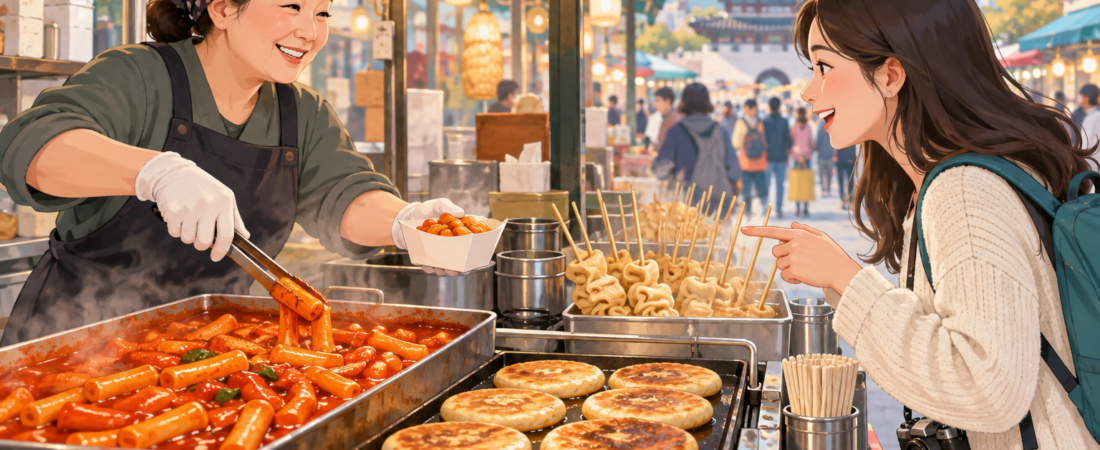
A good first Korean street food stop does not require a checklist of twenty snacks. Choose one savory item and one sweet item, confirm the portion and total, and leave room to explore. Markets can be crowded, so step aside to decide rather than blocking the seller’s working space.
This guide explains common food names and a practical ordering routine. Recipes, spice levels, serving sizes, and seasonal availability differ by stall. The illustration shows recognizable examples, not a verified menu from a particular market.
Start with these street-food names
| Food | Typical style | Question worth asking |
|---|---|---|
| 떡볶이 / tteokbokki | Rice cakes in a sauce, often spicy | How spicy is this batch, and what is included? |
| 어묵 / eomuk | Fish cake, often on skewers | How are skewers counted and paid for? |
| 호떡 / hotteok | Filled griddle pancake, often sweet | What is inside, including nuts or seeds? |
| 김밥 / gimbap | Seaweed rice roll with fillings | Which fillings are in this version? |
| 붕어빵 / bungeoppang | Fish-shaped filled pastry | Red bean, custard, or another filling? |
| 튀김 / twigim | Fried pieces of various ingredients | What is each piece, and can I choose a mix? |
An easy five-step ordering routine
- Look for a displayed menu and choose the exact item.
- Ask whether the price is per piece, skewer, portion, or set.
- State the quantity and whether you will eat there or take it away.
- Confirm the total and accepted payment method.
- Follow the seller’s collection, seating, and waste instructions.
“이거 하나 주세요” means “One of this, please.” Point clearly as you say it. If you are choosing a mixed plate, confirm the total after selecting all pieces. Ask before taking a skewer or helping yourself to a cup; an open display does not automatically mean self-service.
Local-style practical tip: Keep a small amount of cash accessible, but ask about cards instead of assuming every stall is cash-only. Do not display your entire travel cash reserve while juggling hot food.
Choose for taste, not just the photo
Tteokbokki sauces may differ greatly in heat and sweetness. A pale fish cake is still fish-based, and a fish-shaped pastry is a shape rather than proof that it contains fish. Fillings and preparation can change, so check the actual item. For allergies or strict dietary needs, use a specific written question; if the seller cannot verify the ingredients, choose something you can confirm elsewhere.
Hotteok filling can be much hotter than the outside suggests. Let it cool and take a cautious first bite. Keep skewers and hot cups away from children’s faces and crowded walkways. A long queue is not a guarantee of food safety; look at how the stall handles and stores the food, and skip anything that concerns you.
Eat without obstructing the market
Use the stall’s eating space if available. Otherwise, ask where it is suitable to stand; do not lean on another vendor’s counter or block a shop entrance. Ask before filming a close-up of staff or customers. Keep wrappers until you reach a suitable bin, and return skewers only to the place the vendor indicates.
Local-style practical tip: For a small tasting route, select two nearby stops rather than carrying several open dishes at once. Eat the hot item first, clean up, then move on.
FAQ
Are these foods available all year? Not everywhere. Some snacks, especially warm filled pastries, are strongly associated with colder seasons; check local availability.
Should I bargain over food prices? Start by confirming the displayed price and portion. Do not assume a market meal is a bargaining transaction.
Related guides
Useful phrases · Payment backup · Waste disposal
Sources and checks
- VISITKOREA: Bunsik & Street Food — dish descriptions
- VISITKOREA: Winter K-Snacks — seasonal hotteok and pastries
Last checked: September 14, 2026. This guide combines the linked reference information with practical travel suggestions. Venue policies and services can change; follow current signs and staff guidance.

