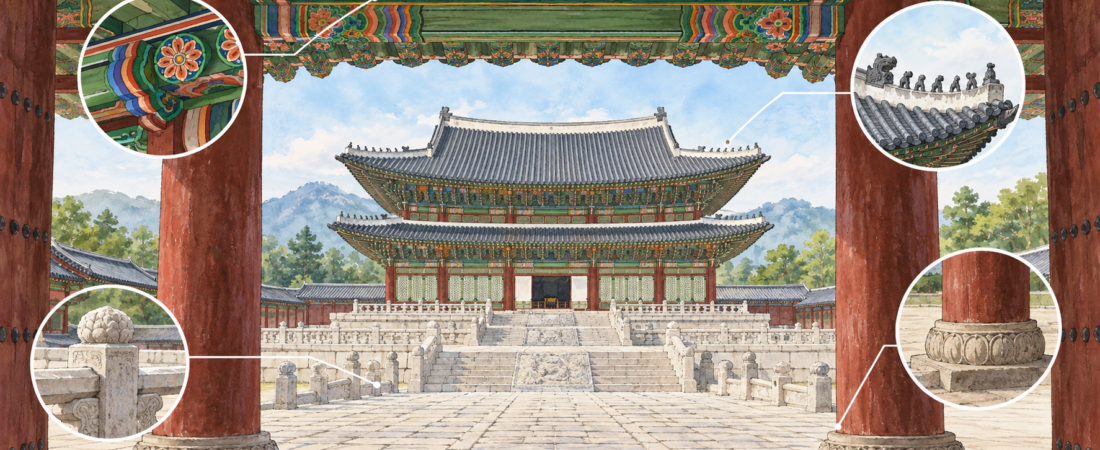
Many visitors leave a Seoul palace with a camera full of roofs but only a vague sense of what the buildings did. Try reading the site as a sequence of spaces. A gate controls the approach; a broad court sets a ceremonial scale; the largest hall often served a more public function than a smaller residential room. That pattern is a useful lens, not a rigid floor plan for every palace or every period.
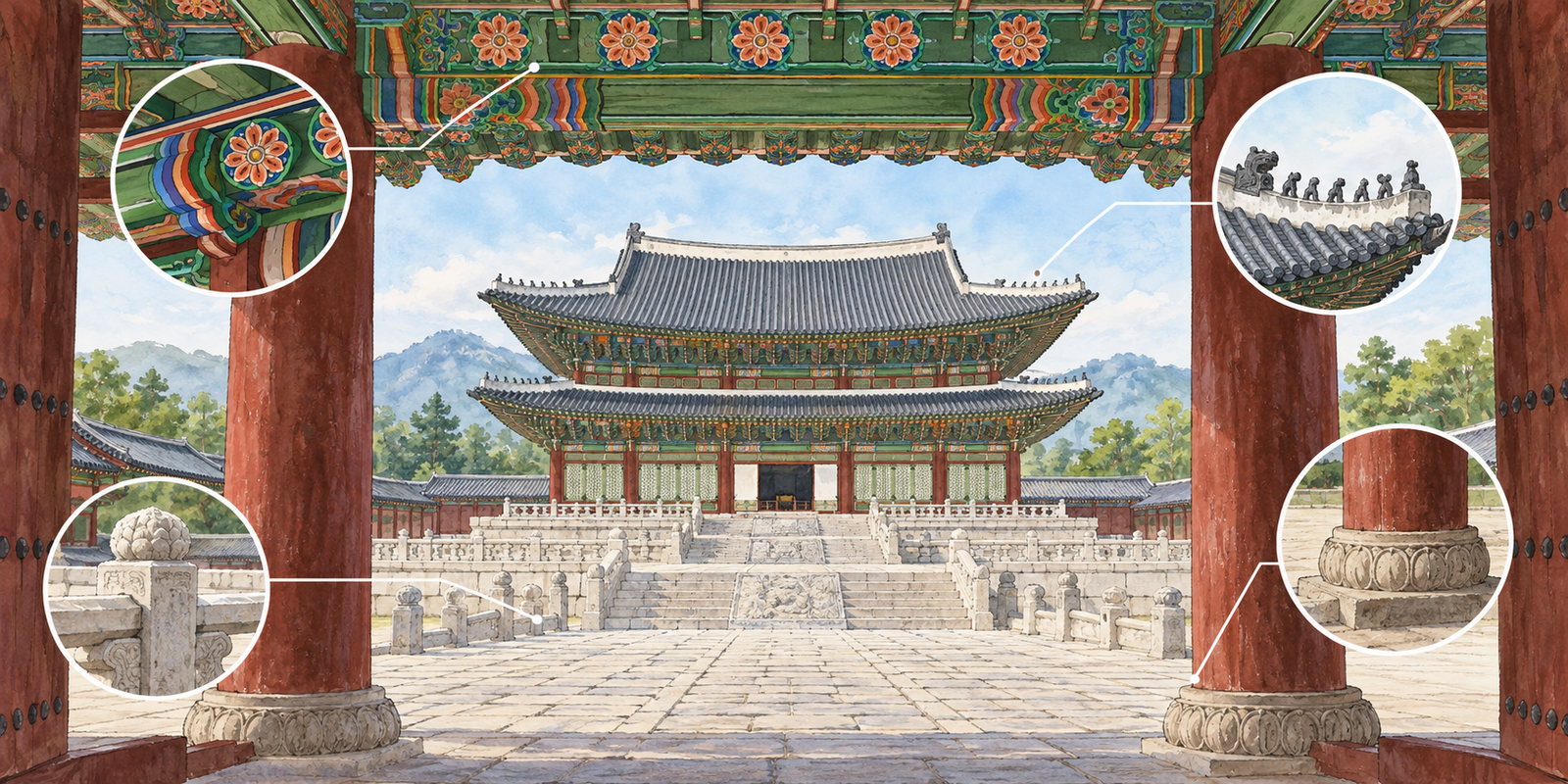
A five-stop looking route
| Stop | Look for | Question to ask |
|---|---|---|
| 1. Entrance gate | Scale, doors and sightline | What becomes visible only after you pass through? |
| 2. Open court | Stone surface, steps and distance to the hall | How does the empty space create ceremony? |
| 3. Main hall | Raised platform, columns and roofline | Who would have used this room, and for what? |
| 4. Eaves | Painted patterns and timber brackets | Where is decoration concentrated? |
| 5. Quieter quarters | Smaller buildings, enclosed routes and garden edges | How does the mood change away from the formal core? |
A quieter palace scene I remember
On a night visit to Changgyeonggung, I walked around Chundangji pond. There were not many people around during my visit, so I could take a quiet stroll. The pond under the evening lights was the most memorable part for me; walking beside it felt, for a moment, like stepping into an older Seoul. It reminded me that a palace visit is also about how a place feels as you move from a formal space to a calmer path. This is one evening’s experience, not a promise about nightly crowd levels, lighting or access. Check the palace’s current hours before planning an evening visit.
Why the courtyard is not “empty”
The Royal Palaces and Tombs Center describes the palace as a combination of royal residence and central government. Its guide to palace layout calls the oejeon the more formal outer court, with the principal hall used for state ceremonies and audiences. The space in front matters because it frames rank, distance and approach. Stand at the court’s edge and look back at the gate before rushing up the steps; that reverse view makes the designed sequence easier to understand. This is an observation technique, not a claim that every courtyard had the same ritual use.
Look up, then look down
Painted decoration under palace eaves is often called dancheong. Its color can be striking, but avoid reading every pattern as one fixed code without a site-specific explanation. Notice instead where the colors are concentrated: under roof overhangs, around brackets and on structural timber. Then look down to the stone platform and column bases. The transition from stone to timber is a practical and visual part of the architecture. The official palace architecture guide also distinguishes building names: jeon often denotes a high-status hall, while jeong is a pavilion. Names are clues, not a substitute for the signboard at the particular building.
Two palaces, different spatial stories
Gyeongbokgung is particularly good for studying a more formal approach to the main hall. Changdeokgung shows a different relationship between buildings and land; the heritage authority describes it as following neighboring terrain rather than a prescribed palace layout. At Deoksugung, the coexistence of traditional and Western-style buildings makes a different historical question unavoidable: how did the court’s environment change during the Korean Empire? Compare those questions in our palace chooser.
Do not mistake restoration for forgery
Seoul’s palaces were damaged, rebuilt and restored at different times. At Gyeongbokgung, for instance, the Royal Palaces and Tombs Center traces the 1867 reconstruction and later restoration work. A reconstructed gate can still teach you about a site’s design, but a photo alone cannot tell you the age of each beam. Read on-site labels for construction and restoration dates; distinguish “historically important place” from “every visible surface is original.” This makes the visit more honest and often more interesting.
Practical viewing etiquette
Follow barriers and posted routes even when a doorway looks open. Do not climb ceremonial stonework for a photograph or touch painted timber. If you are visiting in rented hanbok, keep the outfit away from rough edges and allow time to return it. Check opening days and any room-specific restrictions on the official site; the grounds and exhibition interiors need not share access rules.
Sources and update note
Last checked: October 14, 2026. The architectural interpretation draws on heritage-agency materials. The Changgyeonggung pond passage describes one personal night visit; it is not a firsthand survey of every building or palace.