Cheonggyecheon at night is an easy way to add a slower, scenic hour to a busy Seoul itinerary. Start at Cheonggye Plaza, walk beside the water toward Gwangtonggyo and Gwanggyo, and return to street level whenever you are ready for dinner or the subway. The ordinary stream walk is free; for a first visit, allow roughly 30–60 minutes with photo stops.
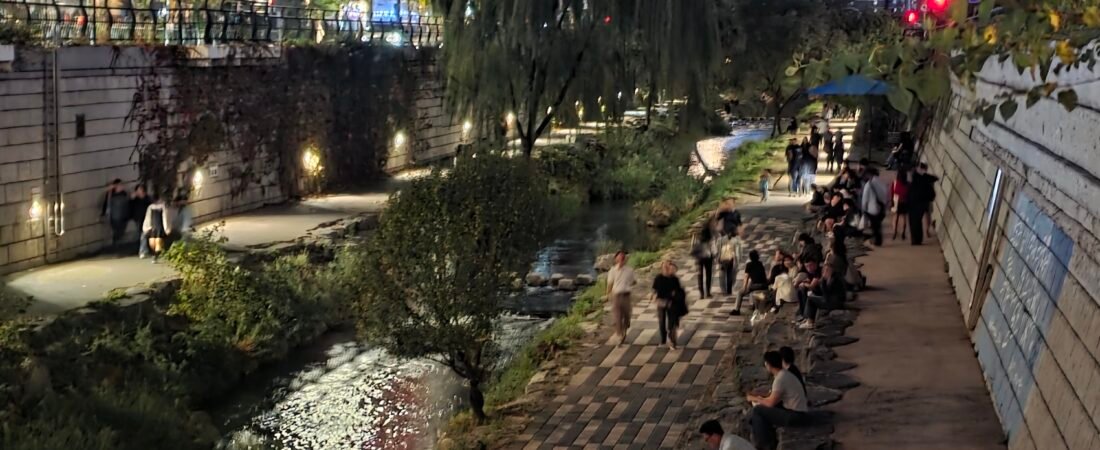
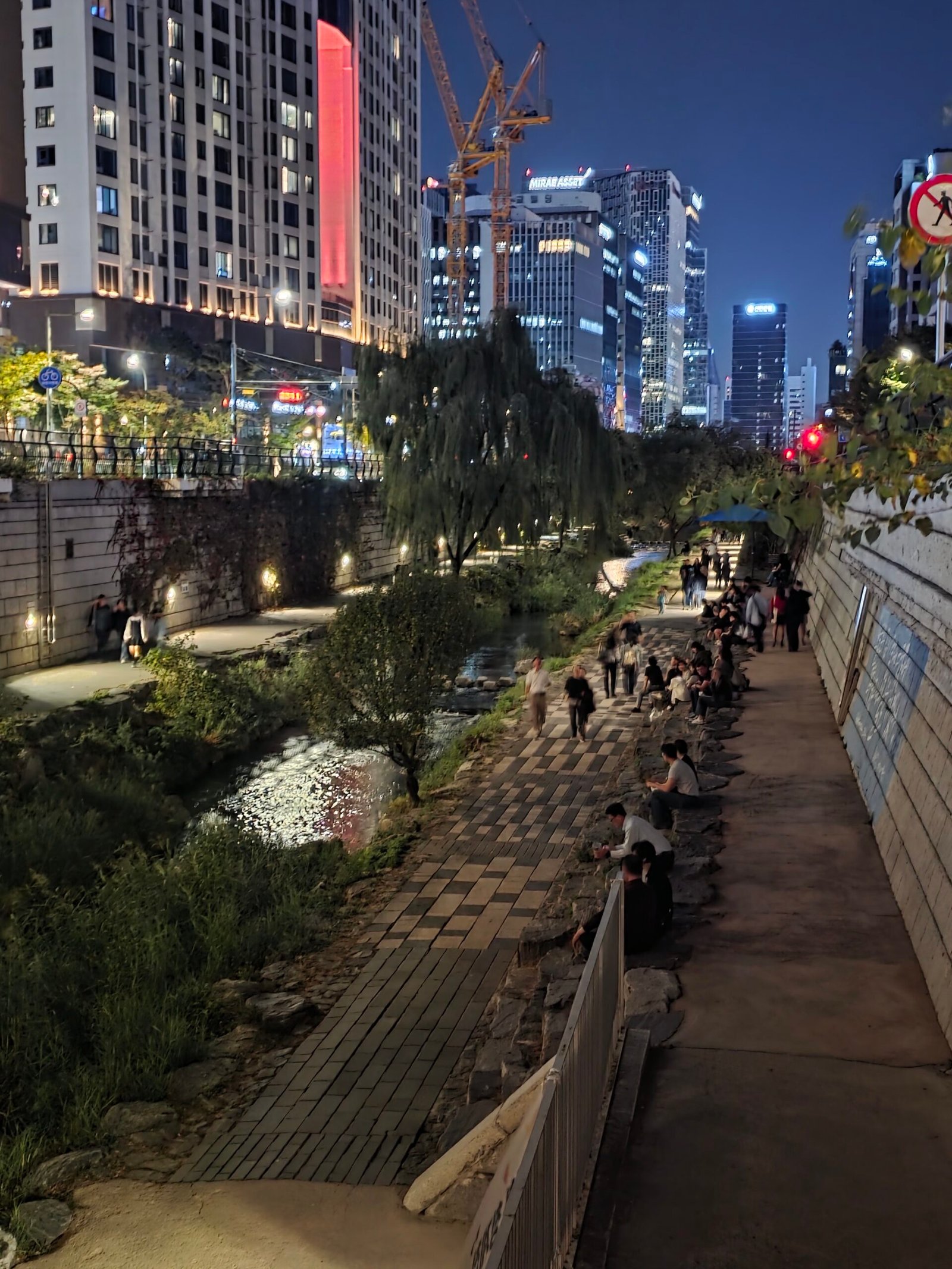
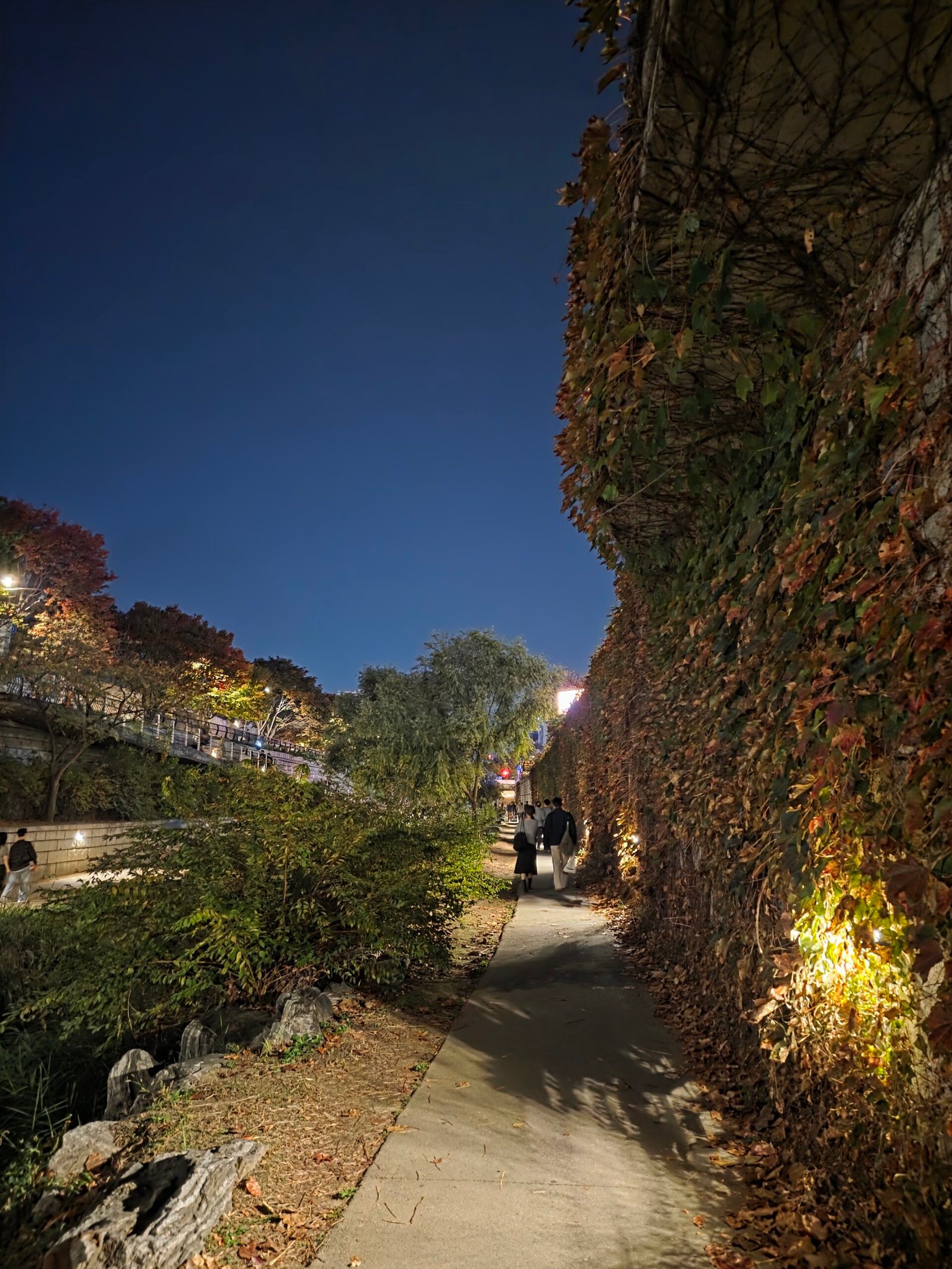
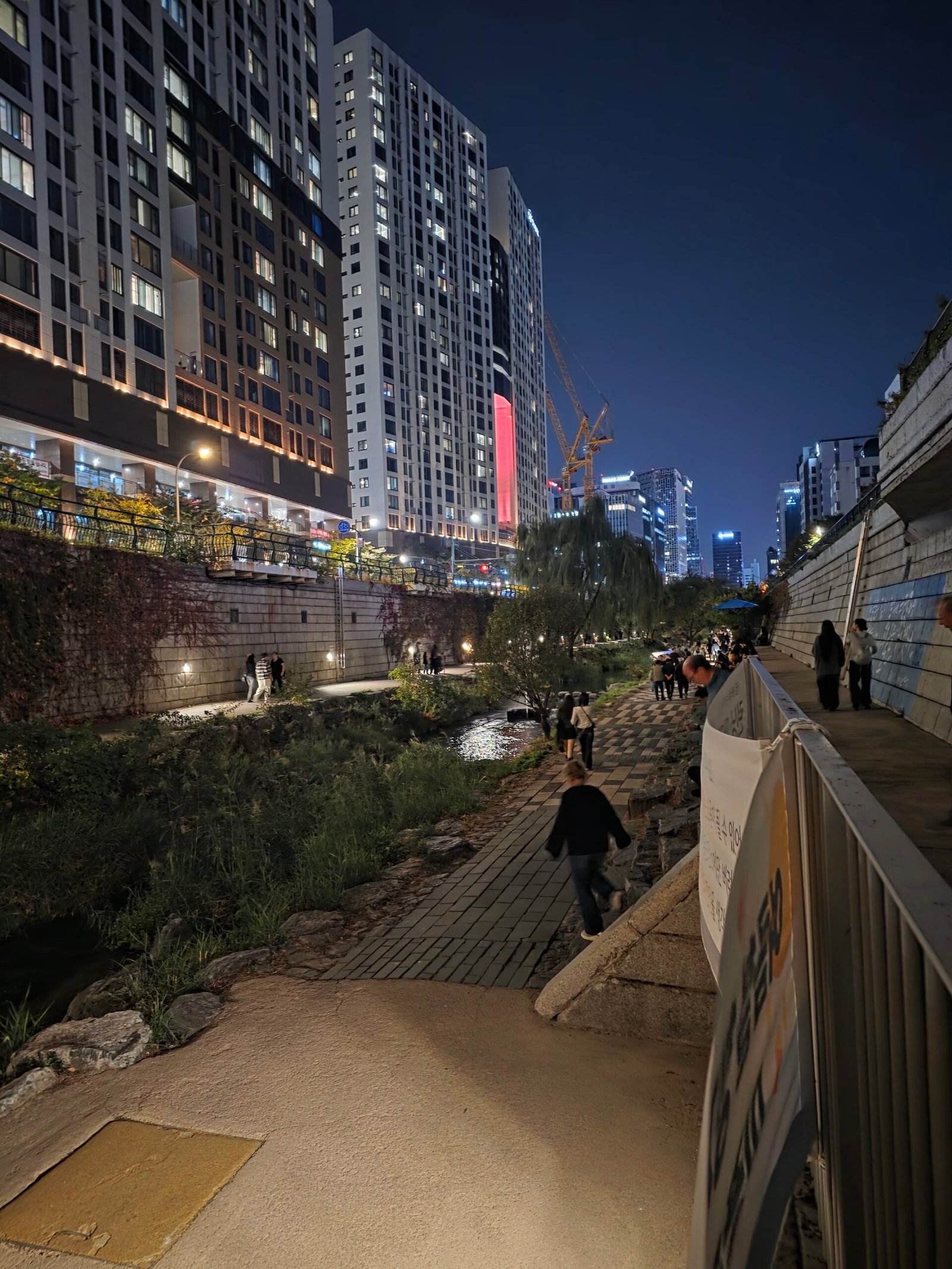
Our original night photographs show three different views of Cheonggyecheon: office lights above the stream, an ivy-covered wall, and the broad change in level between the road and the waterside path. Together they explain the appeal better than calling it simply a “pretty walk”: you can still see the busy city while walking beside water and trees. The suggested 30–60 minutes is a planning estimate, not a measured time from the photo outing. Check weather and access notices before descending to the stream.
From my evening walk: I liked the atmosphere as much as the scenery. Even after dark, I saw people walking, exercising and sitting beside the stream to rest. Seeing all three uses of the path at once made Cheonggyecheon feel like a lived-in part of Seoul, not just a lit-up photo stop. That was my experience on one visit; choose a well-used entrance and stay aware of changing weather and your surroundings.
Why visit Cheonggyecheon after dark?
The appeal is the contrast. Office towers and traffic sit above a sunken corridor of water, stone walls and trees. In the photographs below, reflections break across the stream while people sit along the edges or stroll beneath the city lights. It is a good choice when you want atmosphere without booking another attraction.
Cheonggyecheon is also a restored urban landscape, not simply a decorative fountain. Seoul’s restoration project ran from 2003 to 2005. You do not need to walk the whole restored corridor to appreciate it: a short central section works well after a day of sightseeing. Read the Seoul Metropolitan Government’s overview for the restoration background.
Cheonggyecheon night walk: quick planning guide
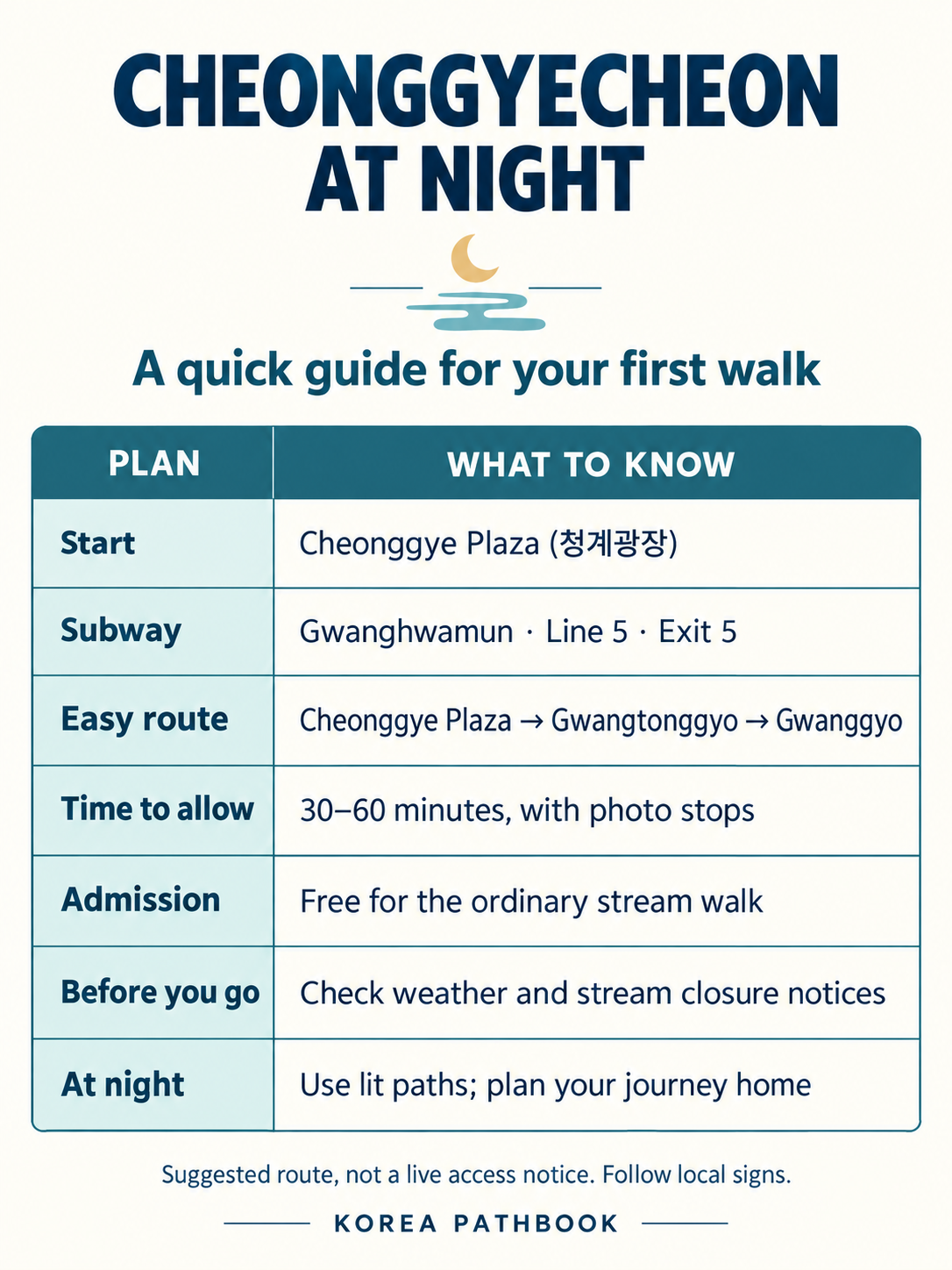
| Plan | What to know |
|---|---|
| Starting point | Cheonggye Plaza (청계광장), central Seoul |
| Subway | Gwanghwamun Station, Line 5, Exit 5 |
| Suggested short route | Cheonggye Plaza → Gwangtonggyo → Gwanggyo |
| Time to allow | 30–60 minutes with stops; longer if you continue farther |
| Cost | Free for the ordinary stream walk; budget separately for transport and food |
| Before leaving | Check the weather and stream closure notices |
| After dark | Use lit paths and plan your return journey |
Where is Cheonggyecheon, and how do you get there?
Cheonggyecheon runs through central Seoul. For this walk, your destination is Cheonggye Plaza (청계광장), the western starting area near Gwanghwamun. Search for that exact place name rather than the stream’s name alone, which can lead a map app to a different section.
By subway: take Line 5 to Gwanghwamun Station and use Exit 5, then follow walking directions to Cheonggye Plaza. This is also the starting approach used by Visit Seoul’s official Cheonggyecheon walking tour. If you need a lift, check the station’s accessible exit and a step-free route separately; the nearest numbered exit is not automatically accessible.
By taxi: show the driver “청계광장” and check the destination pin before departing. Get out at a legal street-level stopping point, then enter through an open access route. The stream operator’s office address is not the starting point for this itinerary.
On your phone: save both your starting point and your hotel before walking. Our Naver Map guide and Seoul subway guide explain the basics. A map pin at street level does not necessarily mean there is an entrance directly below it.
A simple 30–60 minute evening route
1. Begin at Cheonggye Plaza. Take a moment to orient yourself before descending. Look for access signs and identify how you will get back up. Arriving around dusk is a useful option if you want to see the surroundings before the sky becomes fully dark.
2. Follow the stream east toward Gwangtonggyo. Keep the water as your reference and stop where you can do so without blocking the walkway. This is a stroll, not a route that requires rushing through a checklist. Watch for changes between smoother paving, uneven edges and steps.
3. Continue to Gwanggyo, then choose your finish. Return along an open path or leave through a signed exit and continue your evening at street level. If you still have energy, extending toward Samilgyo is another option. Check your map and remaining transport time before committing to a longer walk.
The suggested 30–60 minutes includes pauses and photographs; your pace and chosen exit will change the total. If an entrance or section is closed, use the street-level route instead of crossing a barrier.
Is Cheonggyecheon safe at night?
Seoul can feel comfortable for an evening walk, particularly in active, well-lit central areas, but no city or walking route is risk-free. The UK government’s South Korea travel advice describes crime against foreigners as rare while noting that theft can occur. That national guidance is context, not a guarantee about a particular stretch at a particular hour.
For a solo visit, start earlier in the evening, choose sections where other people are around, and return to street level if a stretch feels isolated. Keep your phone charged and your belongings close. Couples and groups should take the same precautions. Avoid letting headphones or photography distract you from your footing.
Rain and rising water deserve particular attention. The stream is below road level. Follow closure notices, announcements and staff directions, and leave promptly when instructed. Do not shelter under a bridge during heavy rain. Seoul’s official stream guidance explains evacuation precautions; the operator’s Cheonggyecheon notice page carries access updates in Korean.
Stay back from wet edges and do not step into the water for a photograph. Plan the trip home before the last part of your walk: last-train times vary by station, direction and day. If you need urgent help, call 112 for police or 119 for fire or ambulance, as listed by Visit Seoul. Note the nearest bridge name to help describe your location.
Photography tips from these night scenes
These photographs show three useful compositions: reflections framed by willows, the textured ivy wall, and a wider view of the skyline above the stream. You can look for similar contrasts without needing a particular event or a professional camera.
For a phone photo, clean the lens, hold still and tap the bright buildings to avoid an overly bright exposure. Take a few frames from a safe, stationary position. Keep enough room for other walkers to pass, and avoid taking close-up photographs of strangers without permission. Do not climb over railings or move toward the water just to improve the angle.
What else can you do nearby?
Keep the evening flexible: dinner at street level followed by the short walk is often easier than trying to fit in several distant neighborhoods. If you want an indoor stop before the walk, HiKR Ground at 40 Cheonggyecheon-ro offers Korean pop-culture experiences. Check its current hours and floor access before planning around it; a night walk does not mean nearby attractions stay open late.
For a longer evening, compare a route toward Jongno or Ikseondong in your map app. Leave time for the walk between destinations and check individual restaurant hours. The stream itself is the scenic walking portion of the evening, so arrange food and restroom stops before a long stretch.
Questions first-time visitors often ask
Do I need a ticket?
No ticket is needed for the ordinary stream walk. A separate event, activity or nearby attraction may have its own conditions.
Is it open every night?
VISITKOREA lists the stream as open year-round, but that does not guarantee access to every section at every hour. Weather, maintenance and events can change access. Fountain schedules and special lighting are separate from walkway access.
Are lanterns always on display?
Do not plan an ordinary visit around photographs from a festival. Seasonal displays depend on the event’s dates and location. The city lights, water and bridges are the attraction on a regular evening.
Can I visit with a stroller or wheelchair?
Plan the exact entry and exit in advance. The operator lists ramps and elevators among the stream facilities, but not every entrance is step-free. Check the route and current lift availability; stairs and uneven surfaces can make an improvised route difficult.
Where are the toilets?
Check the operator’s facility information and nearby signs before descending. Do not assume every bridge has a toilet or that a nearby building will be open late. Our Korea public toilet guide helps with finding facilities and recognizing signs.
What should I bring?
Comfortable shoes with grip, a charged phone and a layer suited to the forecast are enough for a short walk. In cold weather, keep the route shorter if you are uncomfortable. During heavy rain or a closure, choose another activity.
Who is this walk best for?
It suits first-time visitors, couples, friends and solo travelers who want a low-cost evening outdoors. It is less suitable when you need guaranteed dry-weather access, a completely step-free route without planning, or a late-night attraction with staffed services throughout.
Visitor information checked October 18, 2026. Photographs supplied by Korea Pathbook. Walking times are editorial estimates, not measured journey guarantees. Check official access notices on the day of your visit.