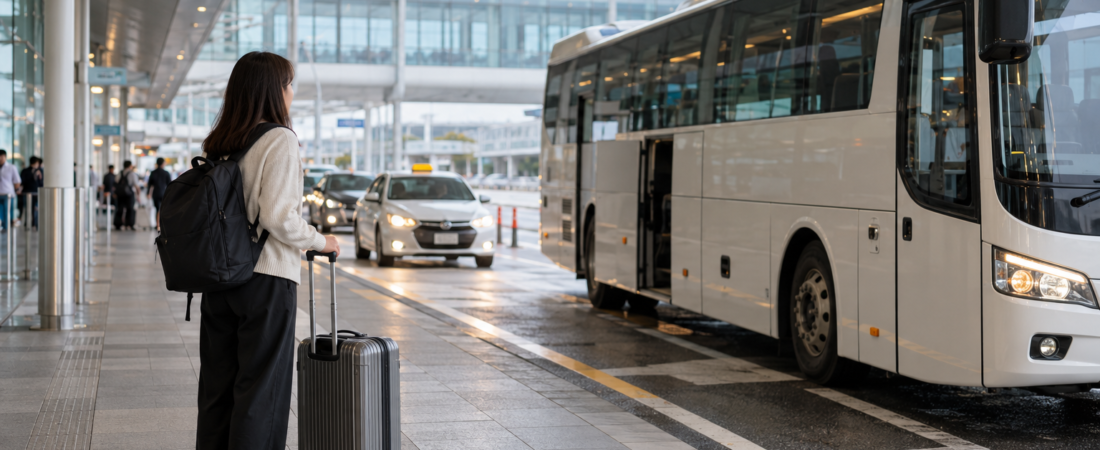
At Incheon Airport, the cheapest-looking ride is not always the easiest one. A bus may drop you close to your hotel; a taxi can make sense for a group with bulky luggage. This guide gives destination-by-destination airport-bus fares, a clearly labeled taxi price benchmark, and a way to get from arrivals to the correct vehicle without accepting a mystery fare.
Before you travel: save your hotel’s Korean address, arrival terminal, destination stop and flight date. Prices below were checked on October 5, 2026; routes and pickup bays can change. If you are still choosing between rail, bus and taxi, read our broader Incheon Airport to Seoul comparison.
Bus fares to useful Seoul and transfer points
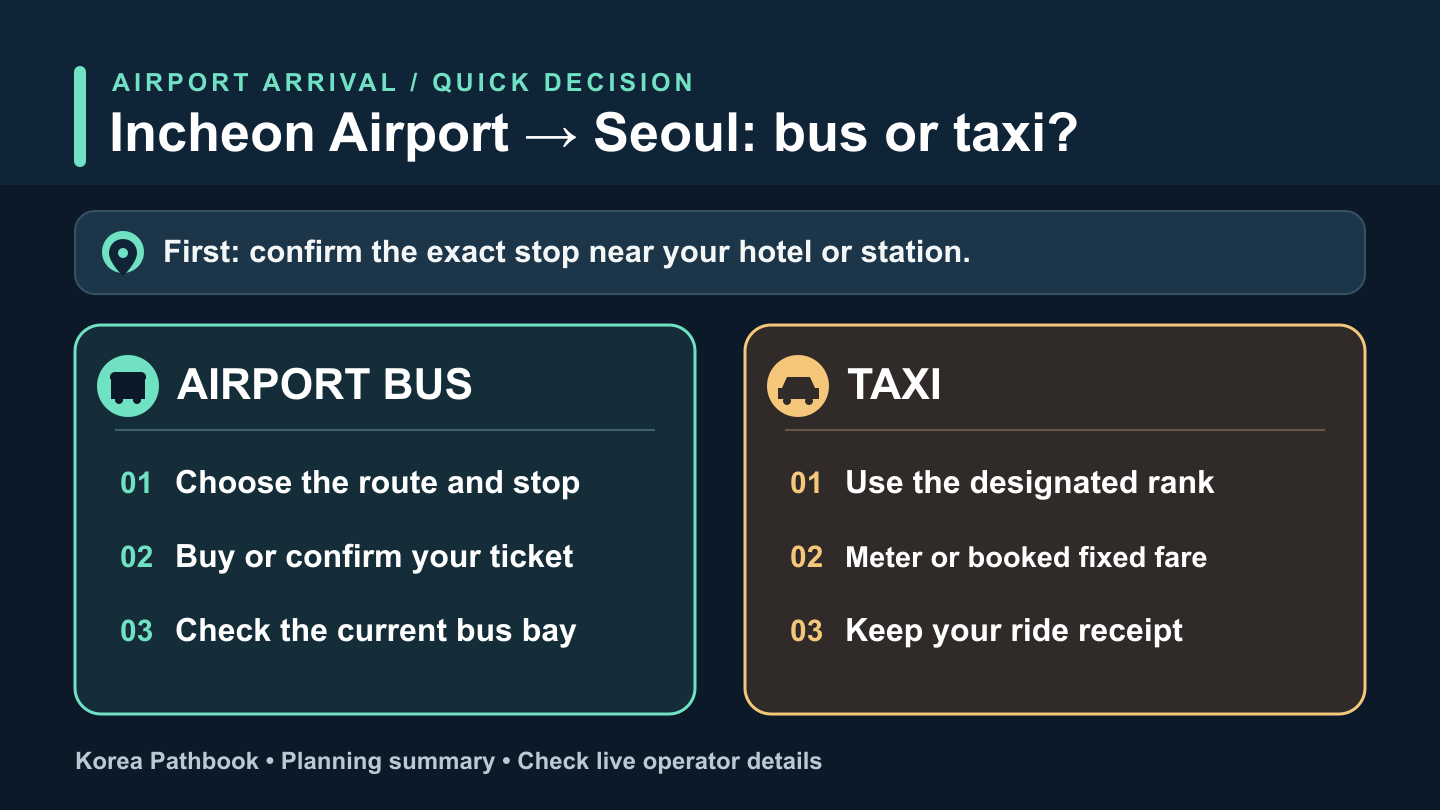
These are adult one-way operator fares, not the cost of the entire trip. A route number is more useful than a district name: Myeongdong has multiple airport-bus approaches, and a stop across a large road can be inconvenient with luggage. Open the operator link and find the stop closest to your exact accommodation.
| Destination or hub | Bus to check | Adult fare |
|---|---|---|
| Seoul Station / Myeongdong | 6001 | ₩17,000 |
| Hongdae / Hongik University | 6002 | ₩17,000 |
| Myeongdong | 6015 | ₩17,000 |
| Gangnam Station | 6009 | ₩17,000 |
| Gangnam Express Bus Terminal | 6020 | ₩17,000 |
| Gimpo Airport | 6003 | ₩8,000 |
| Gwangmyeong KTX Station | 6004 | ₩14,000 |
Two choices worth checking twice: compare the 6001 and 6015 stop lists with your Myeongdong hotel pin. For a KTX connection, compare 6001 to Seoul Station with 6004 to Gwangmyeong—but only after reading the actual departure station on your train ticket. Our KTX booking guide explains that distinction.
What should a taxi cost?
We could not find an official destination-by-destination average for ordinary metered taxis. Traffic, route, time and tolls change the final price. The airport taxi page lists a ₩4,800 regular-taxi base fare; this is not the price to Seoul.
For a transparent benchmark, Seoul’s separate, pre-booked International Taxi service publishes fixed fares: ₩75,000 for the Mapo/Hongdae zone, ₩85,000 for the Jung-gu zone including Seoul Station and Myeongdong, and ₩90,000 for the Gangnam/Seocho zone. Tolls may be additional. These are not ordinary metered-taxi averages or a fare to demand from a standard taxi. Confirm the exact zone and booking terms if you select that service.
For four travelers, four ₩17,000 bus tickets total ₩68,000. This makes a taxi worth comparing, not automatically cheaper: the taxi price still depends on its pricing method and route. Check that the vehicle fits both your group and its bags.
How to board an airport bus
- Finish arrivals. Collect luggage and pass customs. Your landing time is not your bus-stand arrival time.
- Go to the correct level. Terminal 1 bus stops are outside first-floor arrivals. Terminal 2 buses depart from the basement-first-floor Transportation Center. Follow current airport signs.
- Get the right ticket. The operator says Terminal 2 passengers should buy a ticket before boarding. For its 6001, 6002 and 6015 routes at Terminal 1, cash, transit card or ticket boarding is listed on a first-come basis. Other routes can differ.
- Verify route and stop. Show the driver your destination stop in Korean if uncertain; “Seoul” alone is not enough. Keep any luggage claim stub.
- Prepare for the last walk. Open your hotel pin as the bus approaches. A correct stop can still leave a long walk or an inconvenient crossing.
Recheck the Terminal 1 bus guide, Terminal 2 guide and operator boarding notice before travel. The display at your terminal on the day is more reliable than a bay number saved months earlier.
Avoid taxi overcharging
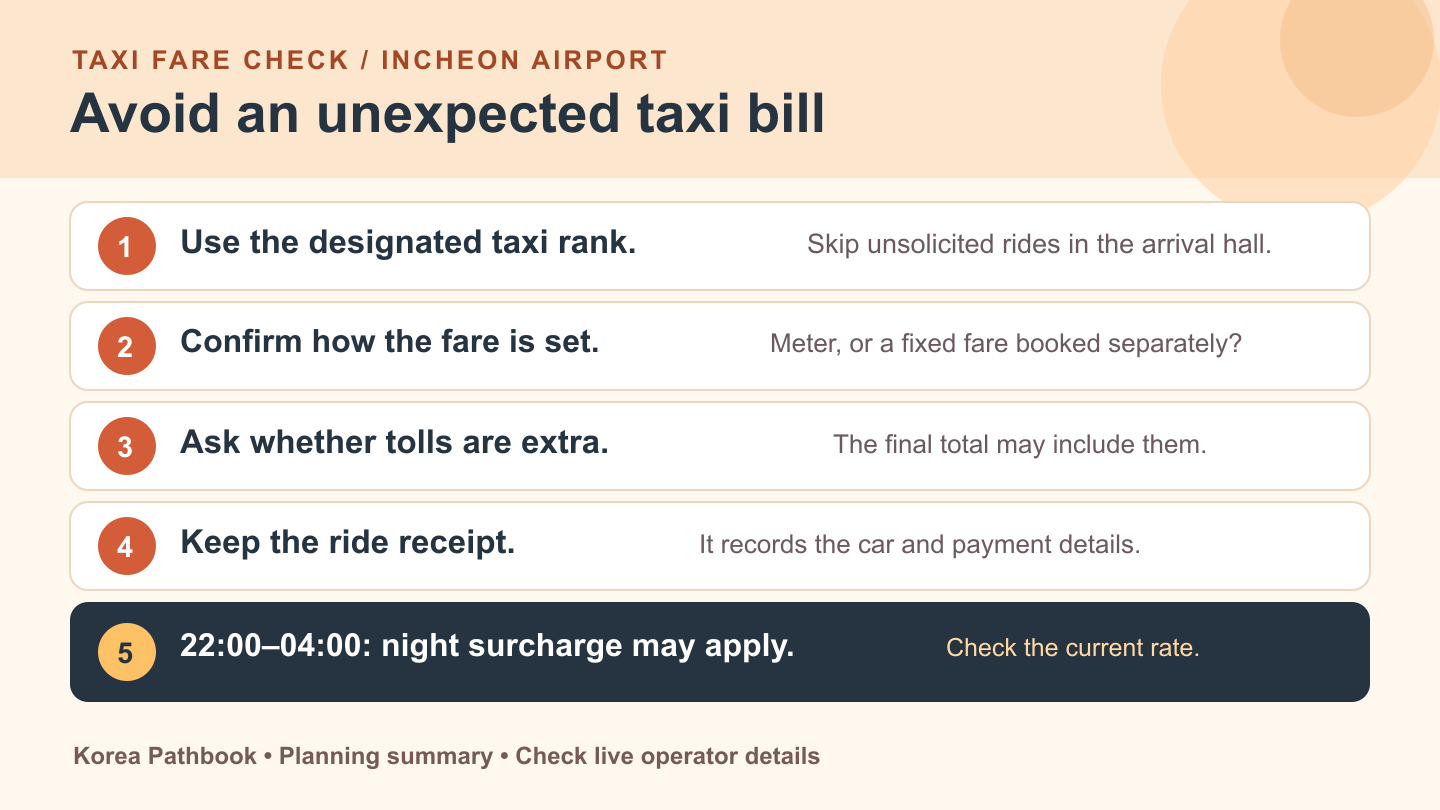
- Use the designated queue. The airport warns against unauthorized solicitation and vehicles posing as taxis. Decline unsolicited offers inside arrivals.
- Confirm the pricing method. A standard taxi should use its meter; a booked fixed-fare service should match its booking record, zone and toll terms.
- Save the Korean address. A map pin helps avoid wrong-destination disputes. Our NAVER Map guide shows how to prepare it.
- Check extras. The airport lists 22:00–04:00 late-night surcharges of 20–40%, depending on time. Seoul-bound journeys should not attract an out-of-city surcharge. Actual road tolls can be charged, but not an invented “return toll.”
- Keep a receipt. Check fare and surcharge before leaving. Record vehicle plate, time and route if you need help from the airport transport desk or Seoul’s 120 service.
These cautions are grounded in the airport taxi guidance and Seoul’s unfair-fare examples. The latter page has older night-hour wording; use the current airport tariff page for late-night hours.
Late arrival and airport connections
Do not assume a daytime bus still runs after immigration and baggage claim. The airport lists separate night services; check your terminal, destination and tonight’s departure before leaving the arrivals hall. If you are connecting to a Gimpo flight, add immigration, bags and a new check-in to the bus or rail journey. The 6003 operator link above is a starting point, not a guaranteed connection time.
Before choosing, compare the next actual departure, total group price, bags and final walk. Save a screenshot of the route and hotel address plus a backup option. See our foreign-card guide and T-money guide rather than relying on one payment method.
Last checked: October 5, 2026. Method: operator route and fare pages, Incheon Airport transport guidance and Seoul city taxi rules. This is a researched planning guide, not a claim that the pictured scene or every journey was photographed or personally tested. Confirm live fares, pickup bays and operating hours at the airport.