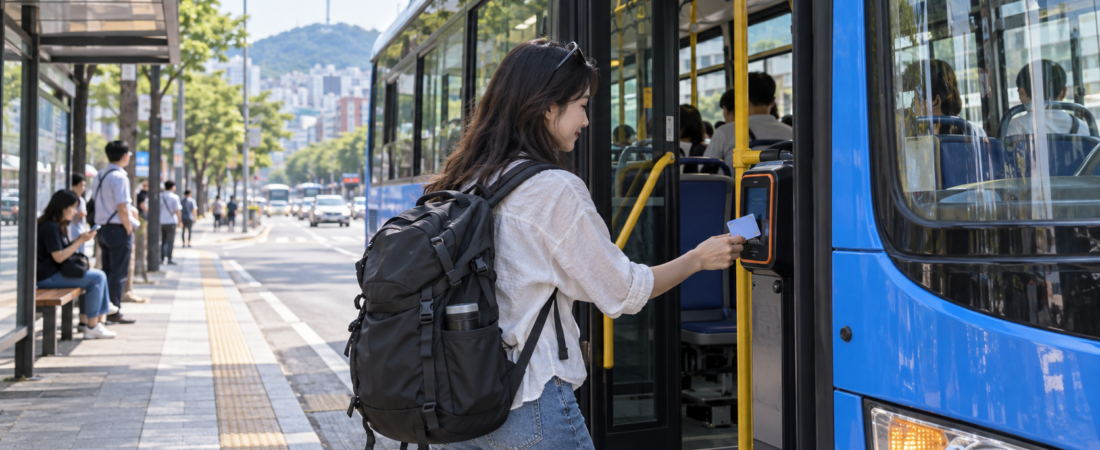
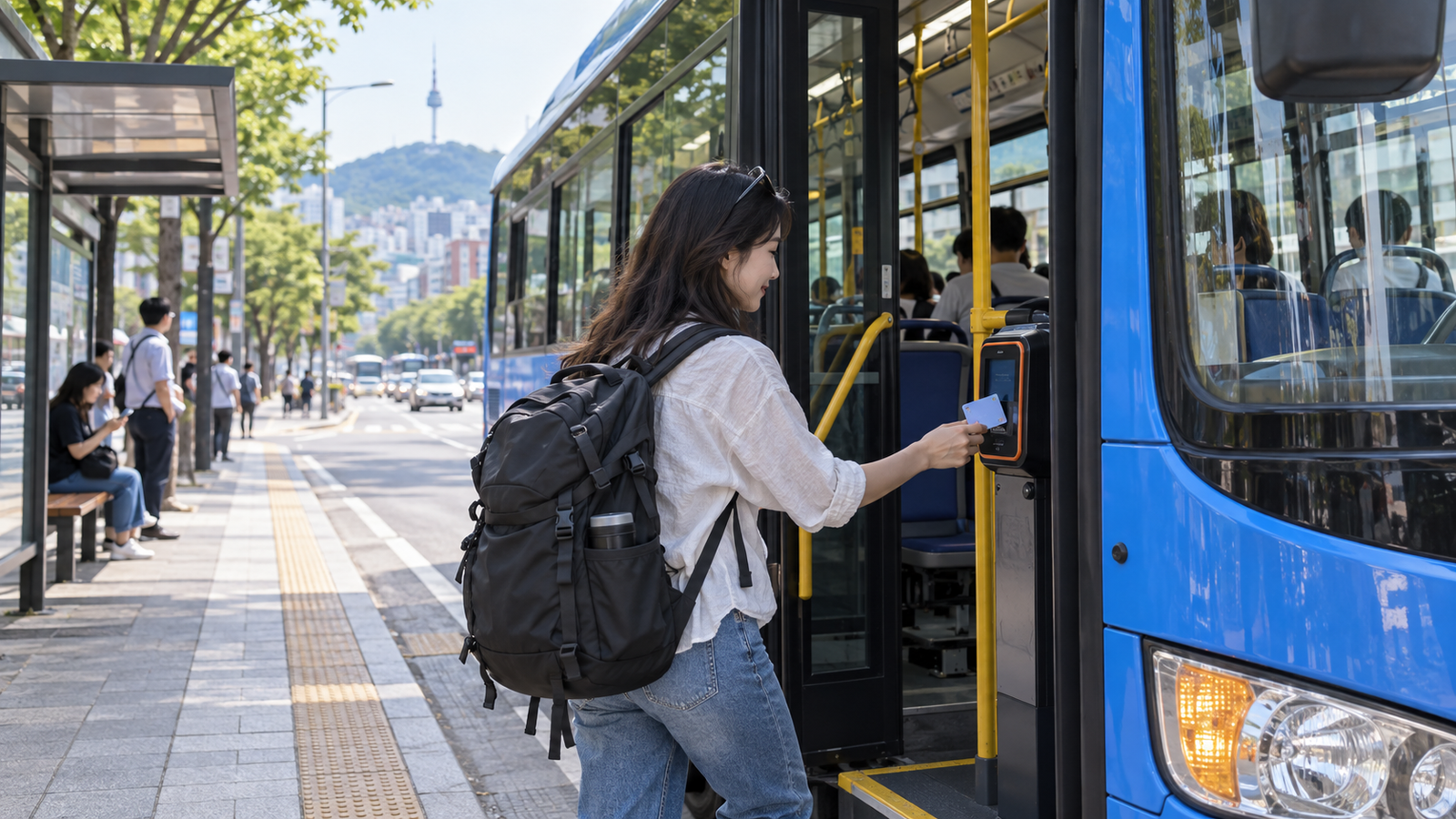
How do you ride a bus in Seoul? In your map app, match the bus number, travel direction and stop ID to the sign on your side of the road. Board through the front door and tap a compatible transit card. Before your stop, press the stop button; then tap the same card and exit through the rear door. The same route number can run in both directions, so checking the physical stop matters more than memorizing a bus color.
This guide is written for visitors using T-money or another compatible transit card. Bus routes and operating details can change, so check your route in NAVER Map or KakaoMap on the day you travel.
Seoul bus basics at a glance
| What you do | What to look for | Common mistake |
|---|---|---|
| Choose the correct stop | Bus number and travel direction in your map app | Waiting across the road for the same number going the opposite way |
| Board | Front door near the driver | Trying to enter through the rear door |
| Pay | Tap the card reader once | Moving the card too quickly before the reader confirms |
| Request your stop | Red stop button inside the bus | Waiting until the bus has already reached the stop |
| Exit | Rear door and card reader | Forgetting to tap off, which can affect transfers or later fares |
1. Find the right bus and the right side of the road
Search your destination in NAVER Map, then choose the public-transport tab. Do not rely only on the bus number. Confirm the stop name, the next major stop and the direction shown in the app. Two stops with similar names may sit on opposite sides of a wide road.
The app normally shows the number of stops remaining and real-time arrival information. Treat the estimate as guidance rather than a promise: downtown traffic, demonstrations and weather can change arrival times. If an arrival looks wrong, compare the stop ID on the physical sign and check the stop display or Seoul’s official bus information site before choosing a different route.
Local tip: Take a screenshot of the stop name and the two stops immediately before your destination. It is much easier to check a saved image on a crowded bus than to reopen a route after your data connection drops.
2. Understand the bus colors
In Seoul, blue buses generally travel on major routes across districts, green buses connect neighborhoods and subway stations, yellow buses circulate in limited areas, and red buses link Seoul with parts of the surrounding metropolitan area. Visitors do not need to memorize every type, but the color helps you recognize the correct vehicle as it approaches.
3. Board at the front and tap your card
Queue near the marked boarding area when possible. Enter through the front door and place your transit card flat against the reader until you hear the confirmation sound. If you are traveling with a child or more than one person on a single card, speak to the driver before tapping; the easiest option for most adult travelers is one card per person.
If the bus is crowded, move inward instead of stopping beside the card reader. Hold a rail before the bus starts moving because drivers may pull away quickly.
4. Follow your progress without missing the stop
Keep the route screen open and compare the Korean stop name in the app with the display inside the bus. Many buses provide recorded announcements, but volume and English coverage vary. Start watching closely two stops before your destination.
Press a stop button after the bus leaves the stop before yours. One press is enough. A light or message usually confirms that a passenger has requested the next stop.
5. Tap off and exit through the rear door
Move toward the rear door only when it is safe. Tap the same transit card on the exit reader, wait for confirmation, and step off through the rear door. Tapping off matters because Seoul’s integrated fare system calculates transfers and distance. If you plan to transfer, follow the route in your map app and board the next service within the permitted transfer window.
Useful Korean words on the bus
| Korean | Meaning | When it helps |
|---|---|---|
| 버스 정류장 | Bus stop | Searching signs or maps |
| 이번 정류장 | This stop | On the information display |
| 다음 정류장 | Next stop | Listening for your destination |
| 내립니다 | Getting off | If the exit is crowded |
| 감사합니다 | Thank you | A polite word to the driver |
Mistakes that cause the most stress
- Checking only the bus number and not the direction.
- Standing at a nearby stop with a similar name.
- Letting a phone battery drop too low before the return journey.
- Forgetting to tap off.
- Trying to cross several lanes after getting off. Use the nearest marked crossing instead.
Frequently asked questions
Can I use T-money on Seoul buses?
Yes. T-money is the simplest payment method for most visitors. Read our T-money guide before your first ride.
Can I use a subway single-journey ticket on a bus?
No. A subway single-journey ticket is for the subway, not a Seoul city bus. Before you reach the bus stop, prepare a compatible transit card with enough balance. If you only bought a single-journey subway ticket, arrange a transit card before boarding.
Is English available?
Many central routes provide some English announcements and displays, but coverage is not identical on every bus. A Korean map app remains the most reliable backup.
What if I miss my stop?
Get off safely at the next stop, then recalculate. Do not rush toward the door after it starts closing. In many cases, walking back one stop is easier than making another bus transfer.
Related Korea travel guides
The 30-second check before boarding
- Match the bus number, not only the color.
- Check the destination direction and the next two stops in NAVER Map.
- Compare the stop ID shown in the app with the ID on the physical sign.
- Board through the front door, tap once and keep the route open until your stop is two stops away.
- Press the stop button, move toward the rear door and tap again when leaving.
Local tip: two stops with similar names can sit on opposite sides of a wide road. The stop ID is a safer final check than the English name alone.
How this guide was prepared: boarding and transfer guidance was checked against the Seoul Metropolitan Government’s official public-transport information. Live arrivals, detours and stop locations should be checked on the day of travel.
Last checked: October 1, 2026
Official sources: Seoul Metropolitan Government public transportation guide and Seoul bus policy information.