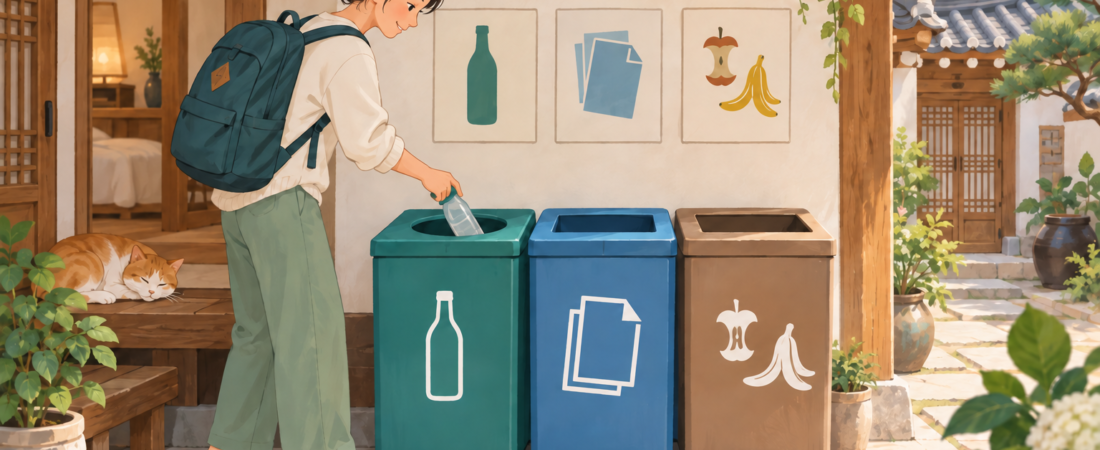
The most useful first step in a Korea recycling guide is to ask your accommodation how its waste system works. A hotel, guesthouse, and apartment rental can use different collection arrangements. Do not buy a random colored bag or leave rubbish on the street because you saw somebody else do it nearby.
This guide separates general travel habits from examples drawn from Seoul’s official guidance. Korea does not have one universal bag color, collection day, or building layout. For the correct bag, location, and time, follow the current instructions for your address.
Start with the main waste streams
| Type | Practical starting point |
|---|---|
| General waste | Use the accommodation’s designated system; ask whether local standard bags are required. |
| Recyclable packaging | Empty it, follow cleaning instructions, and sort by the labeled material stream. |
| Food waste | Separate eligible leftovers from packaging and excluded items; follow the building’s container or bag system. |
| Batteries, electronics, bulky items | Ask for the special collection route; do not put them in ordinary recycling. |
Four questions to ask your host
- Which bins or bags should I use for general waste, food waste, and recycling?
- Where is the collection point for this building?
- When may I put the waste out, including before checkout?
- What should I do with an item that does not match the labels?
Local-style practical tip: At check-in, take a photo of the host’s sorting instructions—not other residents or private spaces. It is easier to follow one clear reference than to translate every bin again on checkout morning.
Food waste: not everything from a meal belongs there
Seoul’s published separation guidance excludes items such as meat and fish bones, shellfish shells, eggshells, and tea grounds from its food-waste stream. These examples are a warning against treating the food bin as a place for every kitchen leftover. Ask about borderline items and follow the current local list.
| Example item | Seoul guidance / what to do |
|---|---|
| Meat or fish bones | Not food waste; use the instructed general-waste route. |
| Shellfish shells and eggshells | Not food waste. Keep them separate from edible leftovers. |
| Tea grounds or tea bags | Not the food-waste stream in the cited guidance; separate other materials as instructed. |
| Leftover rice or suitable soft food scraps | Use the local food-waste system after removing packaging and excess liquid. |
| Skewer, foil, plastic spoon | Not food waste; sort by local material instructions. |
Do not put plastic bags, chopsticks, or wrappers into a food-waste machine. If the building uses an access-controlled or volume-based device, ask the host to demonstrate it; do not use another resident’s card or force the lid. Keep the area tidy and report a problem rather than leaving an open bag beside the machine.
Packaging: empty first, then read the label
A container with leftover food is not ready to be treated like a clean bottle or carton. Empty it and follow the host’s cleaning and separation instructions. Mixed-material lids, films, and heavily contaminated items may need a different route from the main container. A recycling symbol does not guarantee that the local collection point accepts that item in its current condition.
Local-style practical tip: Keep a small temporary sorting area in your room: one space for clean packaging and one closed container for general rubbish. Separate items as you finish them so checkout is not a single mixed-bag puzzle.
While sightseeing
Carry a small bag for wrappers until you find a suitable public bin or return to your stay. Do not use a shop’s private bin, a planter, or an apartment collection point without permission. At a food stall or cafe, follow that business’s return and disposal instructions.
FAQ
Can I use a convenience-store shopping bag for all rubbish? Do not assume so. Ask whether the local standard waste bag is required.
Can I leave everything for the host? Follow the agreed checkout instructions; hotels and rentals handle this differently.
Related guides
Convenience-store meals · Street-food guide · Cafe returns and bins
Sources and checks
- Seoul Metropolitan Government: Food Waste Separation Guidance — published 2020
- Seoul Metropolitan Government: Living in Seoul — household waste systems; confirm current local arrangements
Last checked: September 14, 2026. This guide combines the linked reference information with practical travel suggestions. Venue policies and services can change; follow current signs and staff guidance.