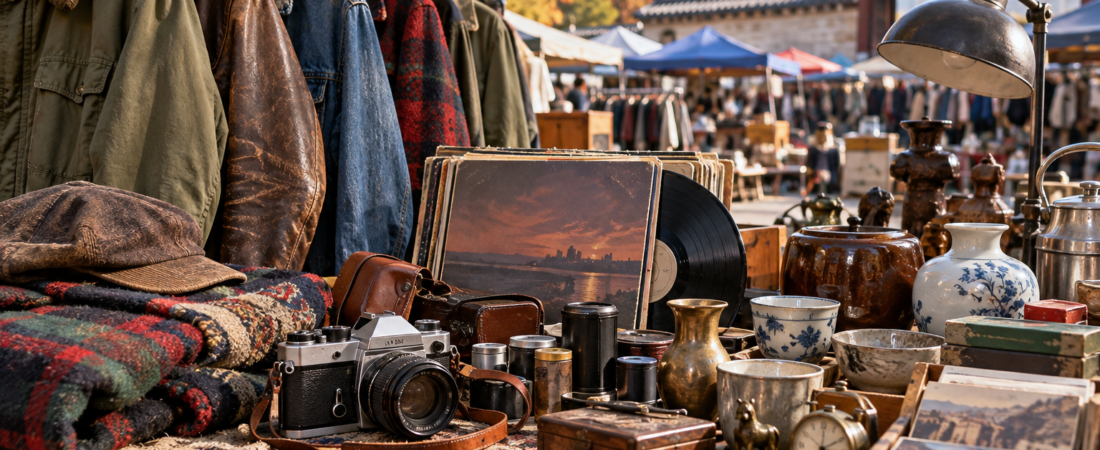
Dongmyo Flea Market is a place to browse, compare and change your mind—not a single store with a fixed inventory. Around Dongmyo Station, clothing, household objects and small curiosities appear in stalls and shops that can differ from one visit to the next. If you are visiting Seoul for the first time, this guide explains how to find the area, what to check before buying and how to combine it with a nearby walk. It is based on current tourism sources and an editorial review of the area, not a claim that we inspected every seller or today’s stock.
Image note: The featured vintage-stall scene is an AI-created conceptual illustration, not a photograph of a specific vendor.
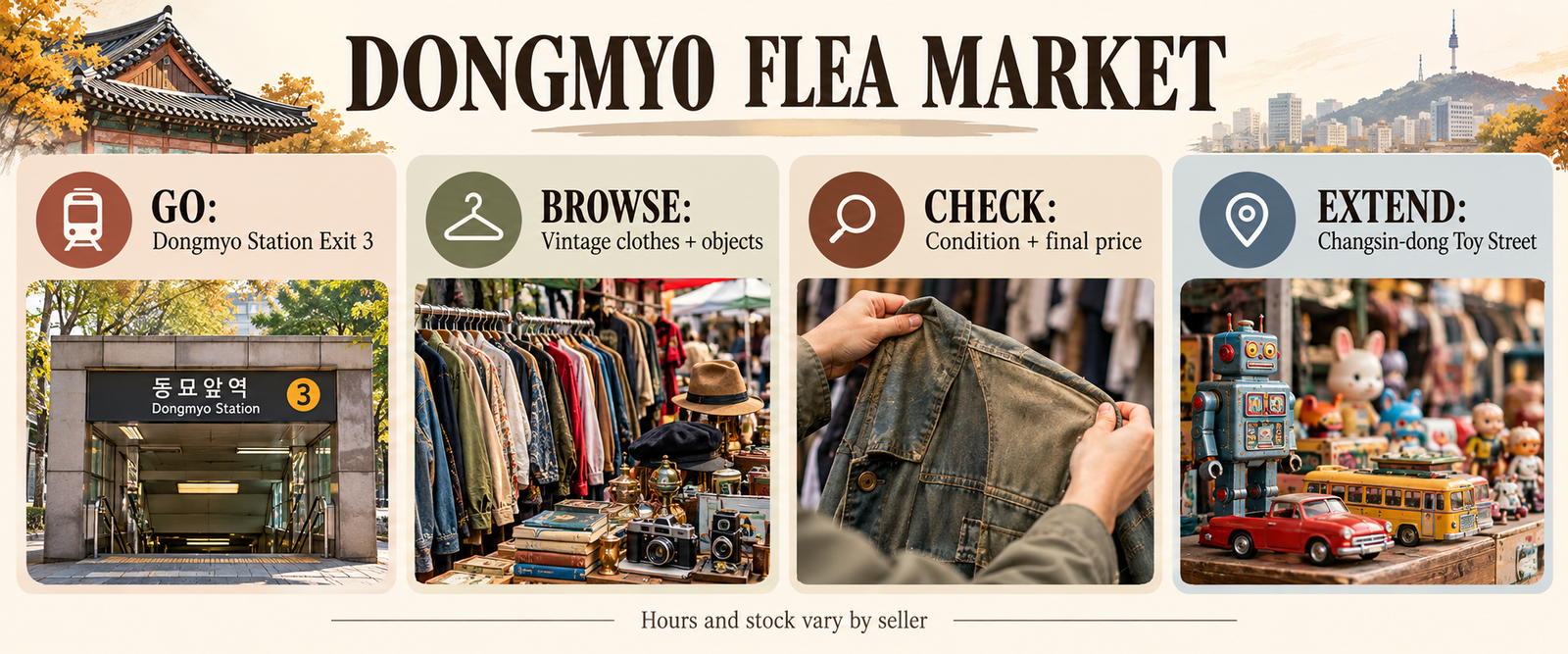
Quick answers before you go
| Question | Useful answer |
|---|---|
| Where do I start? | Dongmyo Station, Exit 3, is the starting point given by Visit Seoul for the market area. Check your map for the exact stalls you want. |
| How long? | Allow roughly 60–90 minutes if you like browsing; longer if you plan to inspect clothes carefully. This is planning advice, not an official visit time. |
| When is it open? | Visit Seoul lists typical market hours, but individual vendors, weather and holidays vary. Do not plan around a single guaranteed opening time. |
| What should I bring? | A small bag, comfortable shoes and a payment backup. Ask each seller which payment methods they accept. |
How to get there and begin browsing
Search 동묘앞역 (Dongmyo Station) in a Korean navigation app, then confirm Exit 3. The area is a network of lanes rather than a museum with one entrance. Once outside, take a first lap without buying: notice which rows lean toward clothes, which shops display objects, and where you can step aside without blocking people. Use our NAVER Map guide if English place search does not find the exact pin.
If you are meeting someone, share a specific shop or station exit—not just “Dongmyo market.” Lanes can look similar, and a seller may move or close. Keep the Korean station name saved offline.
A shopping strategy that works better than rushing
- Browse first. Compare similar pieces across several stalls. The first object you see is not necessarily the best fit or condition.
- Inspect in daylight where possible. Check seams, zips, stains, cracks, plugs, batteries and missing parts. Ask before testing electrical goods.
- Confirm the total price. Point to the exact item and ask 이거 얼마예요? (How much is this?). If buying several items, ask for the total before paying.
- Ask about payment and returns. Cash or card acceptance and exchange policies vary by seller. Do not assume a department-store return policy applies.
- Keep valuables close. This is ordinary crowded-market advice, not a claim that the market has a special safety problem.
What is worth looking for?
Clothing and accessories reward patient browsing because condition and fit differ item by item. Smaller objects—postcards, records, decorative pieces or household items—can be easier to carry than a bulky bargain. If a price seems surprisingly low, inspect the item more carefully instead of assuming it is a rare find. Brand authenticity and product safety are not guaranteed by location; buy only after you can evaluate the item yourself.
For clothes, check the measurements rather than relying on a printed size. If the vendor cannot offer a fitting area, use a garment whose fit you already know as a comparison. For breakable objects, ask for protective wrapping and consider airline baggage limits. For electronics, confirm the plug, voltage, condition and whether the device actually works before paying.
Market manners and a useful Korean phrase
Ask before photographing a seller, person or indoor display; a “public market” is not a blanket photo permission. Do not unfold a whole stack of clothes and leave it messy. A polite 사진 찍어도 될까요? means “May I take a photo?” If you decide not to buy, a simple 감사합니다 (“Thank you”) is enough. Price negotiation may happen at some stalls, but it is not a right; stay friendly and walk away if the price does not suit you.
Can you add Changsin-dong Toy Street?
Yes, as a separate optional stop. Dongmyo Flea Market and Changsin-dong Toy Street are different shopping areas; do not treat them as the same market or expect the same merchandise. If you have extra time, save both pins and check the walking route in NAVER Map. Our Changsin-dong Toy Street guide shows actual Korea Pathbook photos from September 2026 and explains the toy-shopping side. Keep the toy street for after your flea-market browse if you are already carrying purchases.
If it rains, or the market feels too crowded
Outdoor stalls may be less pleasant or limited in bad weather. Keep a flexible backup: a nearby indoor café, another museum or a shorter walk. Peak-time crowds can make careful product inspection harder, so a quieter visit may suit shoppers better. There is no single “best hour” for every vendor. Check conditions on the day rather than relying on an old social-media photo.
Frequently asked questions
Is Dongmyo only for bargain hunters? No. It also works as a street-life walk, provided you leave the vendors room to trade and respect photo boundaries.
Can I pay with a foreign card? Possibly at some sellers, but not universally. Ask before purchase and carry a reasonable alternative. Do not rely on a specific card logo or ATM being nearby.
Is every item vintage or authentic? No. “Vintage” can be a style description, not a verified age or origin. Judge condition and provenance yourself; avoid treating unverified labels as facts.
How this guide was checked
Last checked: October 22, 2026. We used Visit Seoul tourism information for the market area and station access. Vendor stock, hours, prices and payment rules are changeable and must be confirmed on site. The two graphics in this article are editorial illustrations, not first-hand documentary photos. For a related location that we have photographed, see our original toy-street field guide.
Official sources: Visit Seoul: Dongmyo Flea Market; Visit Seoul: 2026 Dongmyo travel feature. Related: Seoul city guide and NAVER Map in Korea.