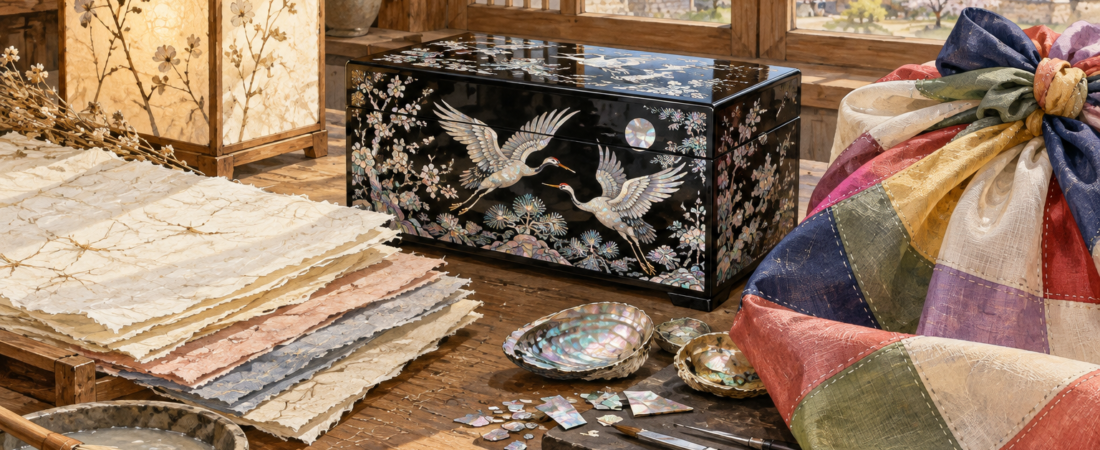
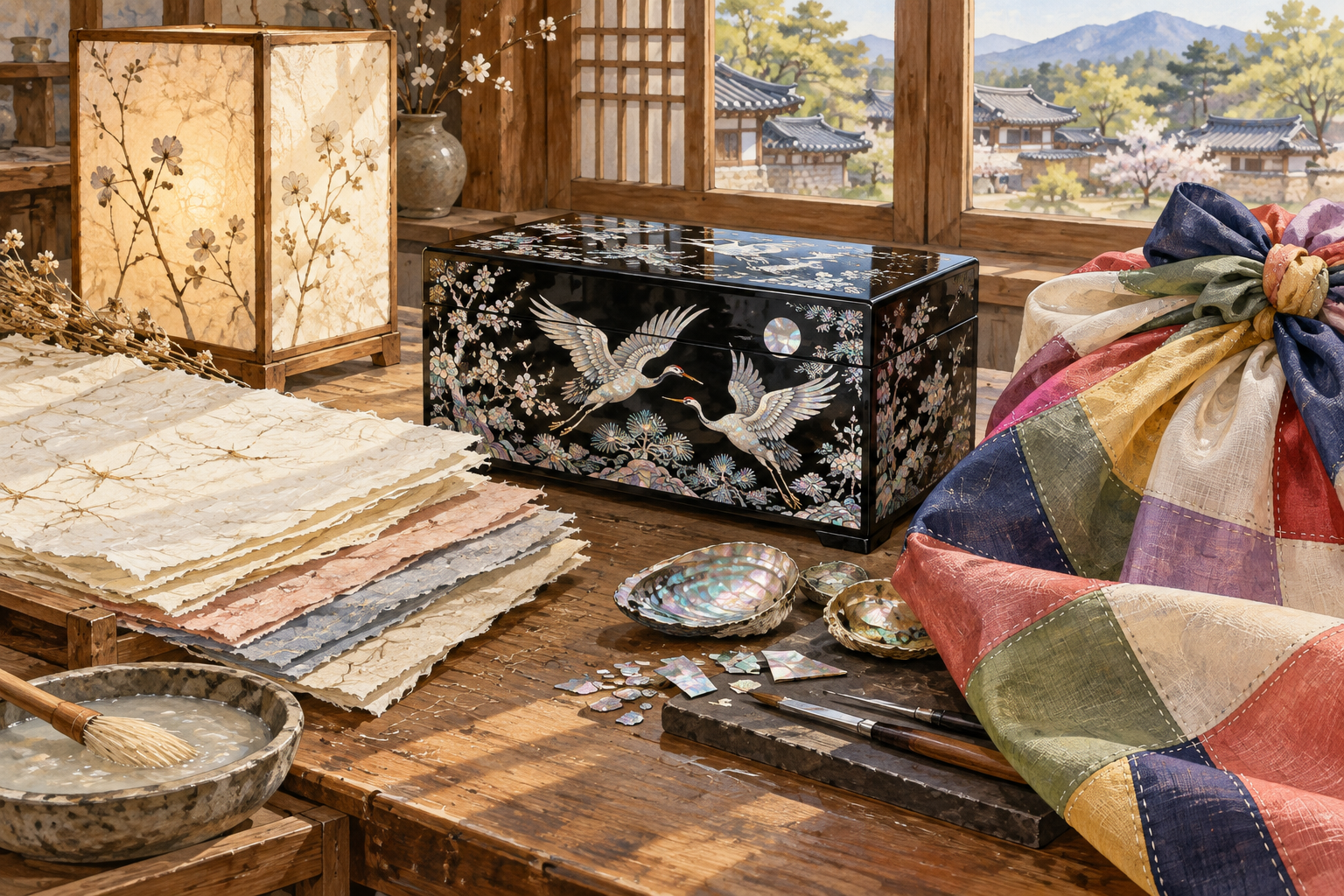
A “traditional Korean souvenir” label can describe very different things: a paper notebook, a lacquer box, a machine-printed cloth or a handmade wrapping textile. Three useful words help you look closer: hanji (traditional Korean paper), najeon (mother-of-pearl inlay, often in lacquerware) and bojagi (wrapping cloth). Learning the material and technique makes a craft market more interesting—and makes it easier to ask what you are buying.
Three materials, three ways of seeing
| Craft | Look for | Useful question |
|---|---|---|
| Hanji | Paper texture, layers, translucency and how it is used in a lamp, box or print | “Is the paper itself traditional hanji, and where was the object made?” |
| Najeon | Iridescent shell inlay set into a decorated surface, commonly lacquerware | “Is this shell inlay or a printed imitation?” |
| Bojagi | Cloth designed to wrap or cover, sometimes with pieced or embroidered construction | “What is the fabric, and was it sewn by hand?” |
Hanji: more than stationery
Hanji is often introduced as Korean paper, but the point for a visitor is what different makers do with it. A lamp lets the paper filter light; a box uses its surface and strength; printmaking uses its response to ink. Korea Tourism Organization describes Hanji House in Bukchon as a place with a showroom, archive, print studio and workroom. Its class and reservation arrangements can change, so check the operator before building a day around a workshop. In a shop, ask whether a product is actually made from hanji or merely has a “hanji-style” print. Neither choice is morally wrong; the distinction is about knowing what you are paying for.
Najeon: the shimmer has a material cause
Najeon refers to shell inlay. In najeonchilgi, thin pieces of iridescent shell are set into lacquerware. Angle a box gently in the light: real shell has a changing depth that a flat printed pattern usually cannot reproduce in the same way. That visual check is useful but not a proof of age, authenticity or handmade production. The shell, lacquer process, substrate and workshop labor all affect price. If a vendor says a piece is antique or handmade, ask for provenance or maker details rather than assuming a high price guarantees it.
Bojagi: a cloth that does work
Bojagi is a wrapping cloth, not just a patchwork pattern on a shopping bag. It can protect, carry or present an object; design choices depend on use. A piece made of joined fabric sections may reveal construction and handwork, while a printed square may be an attractive modern adaptation. Ask whether it is intended for regular wrapping, decorative display or delicate hand washing. Folded flat, a cloth can be a light souvenir, but check care instructions before putting inked or lacquered purchases inside it.
My everyday use: I often use bojagi to wrap gifts. Choosing a cloth with colors I like and tying it around a present is a simple way for me to bring a Korean traditional look into an ordinary exchange. You do not need to have made the cloth yourself to enjoy that use. If you want to try it while traveling, make sure the square is large enough for your gift and ask the shop how to care for its fabric. This is my gift-wrapping experience, not a claim that I attended a bojagi workshop or examined a particular maker’s technique.
How to choose a meaningful class
- Choose the process, not just the photo. Paper-making, assembling a paper object, laying shell fragments and tying a cloth are different skills.
- Check your role. Does the instructor demonstrate a heritage technique, or do participants simply decorate a prepared blank? Both can be enjoyable, but the outcome is different.
- Ask about drying and collection. Lacquer, glue and ink may not be ready to pack immediately; travelers with a flight the next morning should check timing.
- Check language and accessibility. Ask whether instructions are offered in English, whether stairs are involved, and whether children can safely use the materials.
VISITKOREA’s craft guide lists workshops around Insadong and Bukchon, but its article dates to 2023. Treat it as a discovery list, not a live timetable or guaranteed price list. For trip planning around Seoul, use our Seoul guide.
Sources and update note
Last checked: October 14, 2026. The material and workshop guidance is source-based; the bojagi paragraph describes personal gift-wrapping use. We have not claimed to visit or test a specific workshop. Confirm current programs and prices directly with providers.