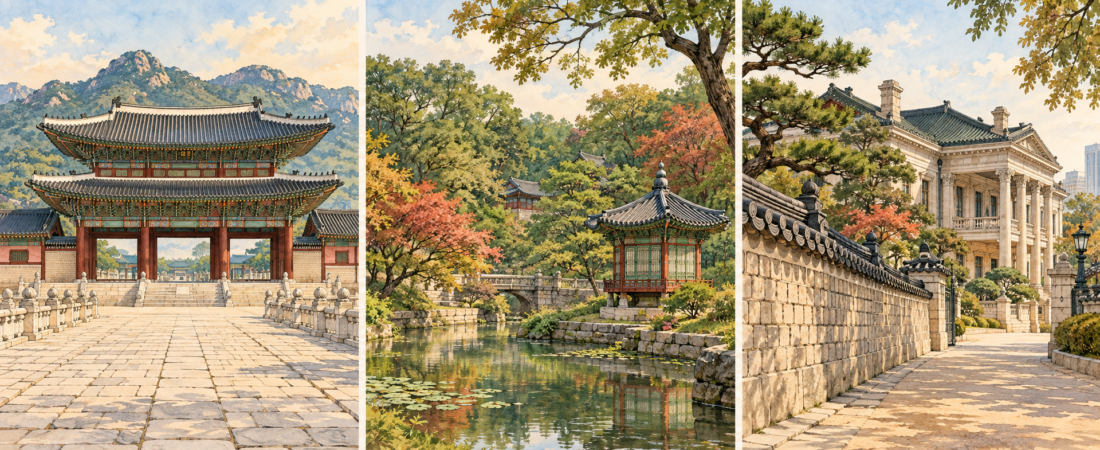
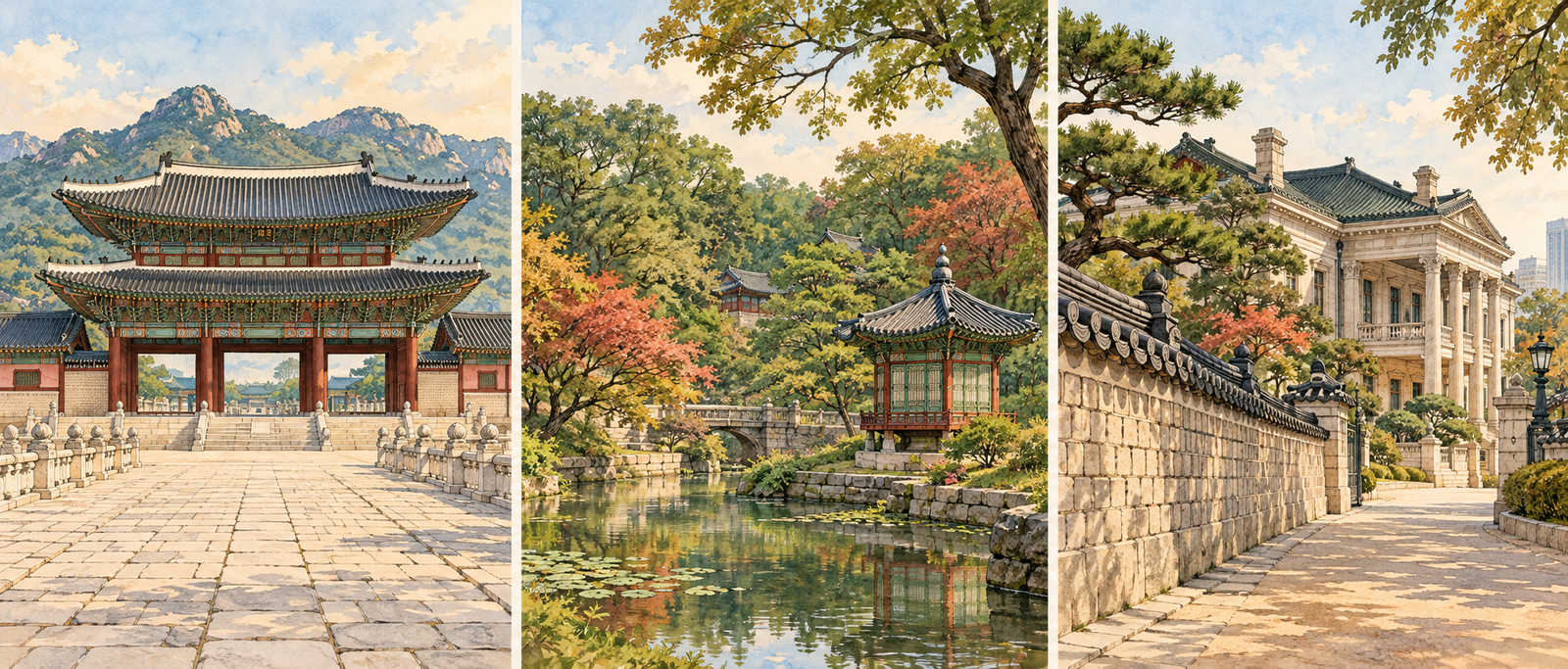
Three palace names appear in almost every Seoul itinerary, but they are not interchangeable. Gyeongbokgung offers the broad ceremonial axis many first-time visitors imagine; Changdeokgung is best for seeing how a royal complex meets its landscape; Deoksugung places the late Joseon court and the Korean Empire side by side. Choose the story you want to understand, then check the day’s opening notice before leaving your hotel.
The quick decision
| If you want… | Start with | Why |
|---|---|---|
| A first royal-palace visit and monumental courtyards | Gyeongbokgung | Its formal approach, gates and large palace grounds make the spatial hierarchy easy to read. |
| Architecture in conversation with terrain | Changdeokgung | Its layout follows the land; the Secret Garden is a separate planning decision. |
| Palace history extending into the Korean Empire | Deoksugung | Traditional halls sit in a complex that also includes Western-style buildings. |
What makes each visit different?
Gyeongbokgung: a clear ceremonial sequence
Built as Joseon’s primary palace in 1395, Gyeongbokgung is the easiest place to read the progression from public gateway to court and main hall. The site has also been destroyed, rebuilt and restored; what you see is not a single untouched 15th-century scene. Walk beyond the first photo stop. Pause at the open court, compare the scale of the buildings behind it, and allow time for a less crowded side route. If your interest is the creation of Hangul, the palace has a direct historical connection: the Royal Palaces and Tombs Center identifies it as the place where Hunminjeongeum was created and distributed.
Changdeokgung: the landscape matters
Changdeokgung was built in 1405 and is recognized as a UNESCO World Heritage site. Its buildings respond to the surrounding terrain rather than forming the same rigid visual axis as a visitor may expect from Gyeongbokgung. That makes it a satisfying choice for travelers who like garden design, architecture and a slower walk. Do not treat the Secret Garden as automatically included with an ordinary palace visit: check current ticketing, timed-entry arrangements and availability separately on the official site.
Deoksugung: a different chapter of history
Deoksugung, formerly Gyeongungung, became the palace of the Korean Empire after its proclamation in 1897. Its mixture of traditional and Western-style buildings is the point, not an accidental mismatch. It can work well for a shorter, focused visit near central Seoul. The main grounds are generally open into the evening, but individual exhibition buildings can have different hours and reservation rules.
Check the calendar before buying anything
| Palace | Regular closure shown by the operator | Planning trap |
|---|---|---|
| Gyeongbokgung | Tuesday | Seasonal closing time changes; final entry is earlier. |
| Changdeokgung | Monday | Secret Garden is a distinct booking and capacity question. |
| Deoksugung | Monday | Exhibitions and the main grounds may not share hours. |
The operator may open on a public holiday and shift the closure to the next non-holiday. For example, its October–November 2026 notice includes special opening periods. So a simple “closed every Tuesday” rule is a starting point, not a substitute for the specific-date notice. Admission prices and special evening events can change too; use the official admission page rather than an old blog price.
Two workable half-day plans
First palace, no special reservation: Start at Gyeongbokgung, spend roughly two hours moving from the main gate toward the inner grounds, then continue to nearby Seoul neighborhoods according to your interests. The two-hour allowance is an editorial planning estimate, not an official tour length. Architecture-focused: Make Changdeokgung the anchor; only add its Secret Garden if you have confirmed the separate entry arrangement and left room for the extra walk. Avoid stacking all three palaces into one tight morning simply because they look close on a map.
Small decisions that improve the day
- Save the palace name in Korean as well as English: 경복궁, 창덕궁, 덕수궁.
- Wear shoes suitable for stone paving and a longer outdoor walk; shade and seating vary by route.
- Use the official site to distinguish general admission from exhibition or garden access.
- If you rent hanbok, confirm the full outfit and the return deadline. Clothing can qualify for palace admission without making the rental itself free.
For navigation outside the gates, see our Naver Map guide and Seoul guide.
Sources and update note
Last checked: October 14, 2026. This is a source-based comparison, not a claim of a recent first-hand visit. Verify live hours, fees and notices before travel.